








Guide : How Cloakroom inefficiency breaks events at scale
What’s Really Happening
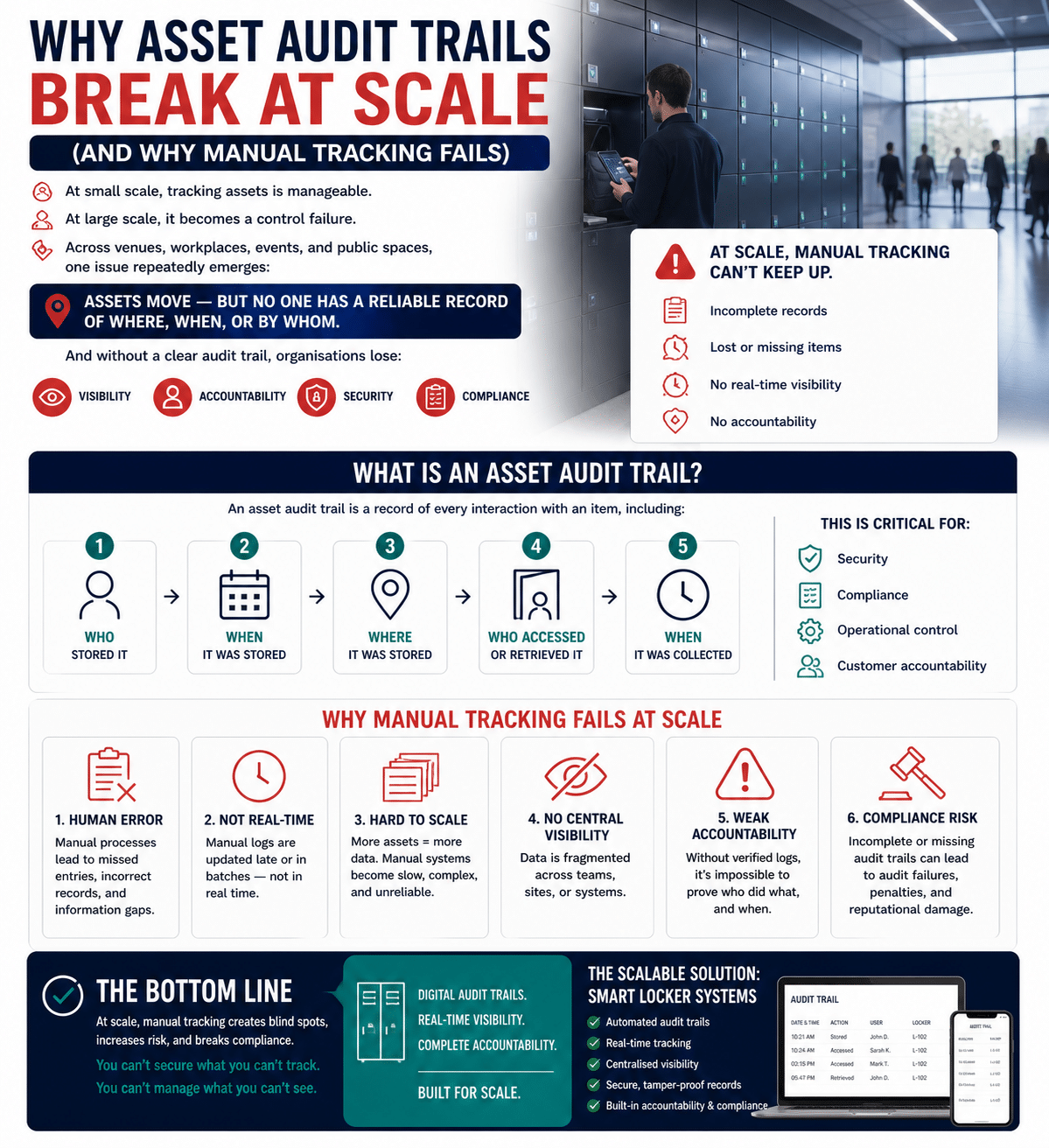
Most asset tracking systems rely on manual input:
- Paper logs
- Spreadsheets
- Tagging systems
- Staff memory
These methods are:
- Inconsistent
- Incomplete
- Error-prone
If data isn’t captured automatically, it isn’t captured accurately
Why Asset Audits Fail at Scale

Why Audit Trails Fail at Scale
Volume overwhelms processes
- Hundreds or thousands of assets move daily
- Peak periods prioritise speed over accuracy
Missing or incorrect records
Multiple touchpoints create gaps
- Drop-off → handling → storage → retrieval
Data lost between steps, no clear ownership
Staff dependency reduces accountability
- Relies on consistent human behaviour
Steps skipped, processes vary
No real-time visibility
- Delayed updates
- Limited tracking
Issues discovered too late
Fragmented systems
- Data spread across multiple tools
No end-to-end audit trail
Guide : Why Traditional Fixes Don't Work

The Hidden Risk
Security Risk
- No chain of custody
- Items cannot be traced
- Suspicious activity goes undetected
Compliance Risk
- Lack of traceability
- Failed audits
- Legal exposure
Financial Loss
- Lost or misplaced items
- Compensation claims
- Inefficiency
Customer Impact
- Lost trust
- Increased complaints
- Brand damage
Operational Drag
- Time spent searching, resolving, correcting
Reduced productivity
Why Traditional Solutions Fail
They rely on people, not systems:
- Paper logs → lost, inaccurate
- Manual digital logs → incomplete, time-consuming
- Barcode/tagging alone → requires discipline, not guaranteed
- Staff-led processes → inconsistent at scale
These approaches cannot guarantee accountability
The Core Problem
Audit trails fail because they depend on human behaviour instead of system design.
At scale:
- People forget
- Processes are skipped
- Data becomes incomplete
Accountability breaks down
The Scalable Solution - Automated, system-driven audit trails
Why It Works
Automatic data capture
- No manual input required
- Every interaction recorded
User-linked transactions
- Full accountability
- No anonymous handling
Time-stamped records
- Complete history of every asset
Real-time visibility
- Know where items are instantly
Centralised platform
- One source of truth
- Full reporting and analytics
Operational Outcome
Automated audit trails deliver:
- 100% transaction visibility
- Reduced loss and misplacement
- Improved compliance
- Faster issue resolution
- Stronger customer trust
The Bottom Line
Bottom Line
Audit trails don’t fail because organisations lack discipline.
They fail because:
Manual systems cannot deliver reliable tracking at scale.
At scale:
- Data becomes incomplete
- Accountability breaks down
- Risk increases
The solution is not better processes.
It’s automated, system-driven tracking.