


Guide : How Cloakroom inefficiency breaks events at scale

Long queues trigger a chain reaction:
- Frustration at entry
- Negative reviews
- Lower return rates
- Brand damage
- Declining ticket sales
Pain Point — Long Queues = Lost Revenue & Reputation
- Time outside = lost spend inside
- Poor first impressions = negative reviews
- Bad experiences reduce repeat attendance
Why Cloakroom Inefficiency Breaks Events at Scale (And What Replaces It)
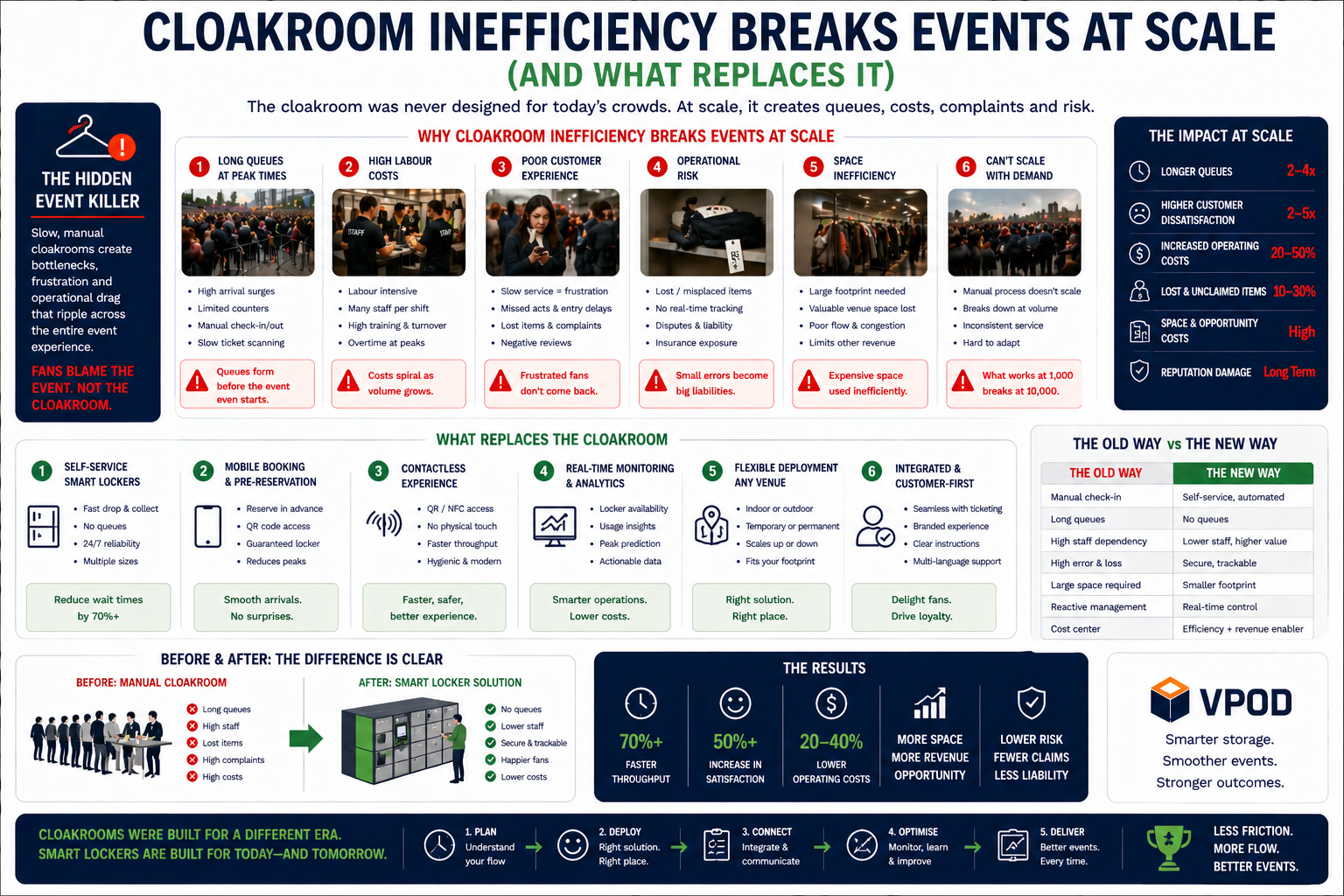
Why Cloakrooms Fail at Scale

What’s Really Happening
Cloakrooms rely on manual, one-at-a-time processing.
Typical capacity:
- 60–120 bags per hour per staff member
At the same time:
- 30–50% of attendees bring bags
- 60–80% arrive within a short window
Demand overwhelms capacity almost instantly
The Structural Failure
Cloakrooms create a double bottleneck:
- Entry queue (bag drop)
- Exit queue (bag collection)
They also sit after security checks, meaning:
- Bags still slow screening
- Friction exists at multiple stages
The problem isn’t solved — it’s duplicated
Guide : Why Traditional Fixes Don't Work

The Hidden Impact
Security Risk
- External queues and تجمع crowding
- Delays entering secure zones
- Increased perimeter vulnerability
Rising Costs
- Large staffing teams
- Temporary infrastructure
- Ongoing management
Costs scale with demand, efficiency does not
Poor Experience
- Long waits on arrival and departure
- Lost or mishandled items
- Frustration and delays
Event Flow Disruption
- Slower ingress
- Congestion inside
- Delayed egress
Cloakrooms impact the entire event lifecycle
Why Traditional Fixes Fail
They attempt to optimize a broken model:
- More staff → higher cost, limited throughput gains
- Larger cloakrooms → space-constrained, still manual
- Better tagging → fewer errors, same speed
- Bag restrictions → poor experience, hard to enforce
These improvements do not change the underlying system
How to reduce event ingress bottlenecks
The Core Problem
Cloakrooms operate as a linear system:
- One transaction at a time
- Staff-dependent
- Fixed throughput
Events operate with exponential demand:
- High volume
- Sharp peaks
- Time constraints
Linear systems cannot handle exponential demand
The Scalable Alternative
Replace cloakrooms with self-service smart lockers
Why It Works
Parallel Processing
- Hundreds of users store bags simultaneously
- No reliance on staff
No Queues
- Instant drop-off and retrieval
- No entry or exit bottlenecks
Removes Friction Upstream
- No manual handling
- No tagging
- No waiting
Improves Security Flow
- Bags stored before entry
- Faster screening
- Higher throughput
Lower Cost Model
- Fewer staff required
- No temporary infrastructure
- Fully scalable
Operational Outcome
Replacing cloakrooms delivers:
- 2–4× higher storage throughput
- Significant queue reduction
- Lower staffing costs
- Improved security flow
- Better visitor experience
The Bottom Line
Bottom Line
Cloakrooms were designed for smaller events.
At scale, they:
- Create queues
- Increase costs
- Introduce risk
They are not a solution. They are a bottleneck.
Strategic Direction
The future of event storage is:
- Self-service
- Scalable
- Designed for flow
The goal isn’t to improve cloakrooms.
It’s to replace them.