






What Are Delivery Staffing Costs?
Delivery staffing costs include all labour required to:
- Receive deliveries
- Log and process parcels
- Store items
- Notify recipients
- Manage collections
- Handle exceptions and issues
This applies across:
- Offices and workplaces
- Residential buildings
- Universities and campuses
- Healthcare environments
- Mixed-use developments
Related Links
/solutions/workplace-smart-lockers/
Why Delivery Staffing Costs Increase at Scale
1. Labour Scales Directly With Volume
Manual delivery systems require:
- Staff to accept each delivery
- Staff to process each item
- Staff to manage each interaction
As delivery volume increases:
- More staff are required
- More hours are needed
- Costs increase linearly
More parcels = more people = higher cost
2. Peak Delivery Windows Drive Overstaffing
Deliveries don’t arrive evenly.
They arrive in waves:
- Morning courier drops
- Afternoon delivery peaks
To cope, buildings must:
- Staff for peak demand
- Maintain excess capacity
This leads to:
- Idle staff during quieter periods
- Inefficient labour utilisation
3. Reception Becomes a Labour Bottleneck
Most delivery operations are centralised at:
- Reception desks
- Mailrooms
- Facilities teams
This creates:
- A single processing point
- High staff dependency
- Limited throughput
One desk cannot scale with hundreds of daily deliveries.
4. Manual Handling Increases Cost Per Parcel
Each delivery requires:
- Acceptance
- Logging
- Sorting
- Storage
Manual Parcel Handling Vs Smart Parcel Lockers
If each step takes time:
- Fewer parcels processed per hour
- Higher cost per item
5. Collection Adds a Second Labour Layer
Delivery is only half the process.
Collection requires:
- Staff interaction
- Identity checks
- Item retrieval
Reception Parcel Handling vs Lockers
This creates:
- Additional staffing demand
- Queue management
- Interruptions to workflow
6. Error Handling Creates Hidden Costs
Manual delivery systems lead to:
- Lost parcels
- Misplaced items
- Incorrect handovers
This requires:
- Investigation time
- Additional staff involvement
- Customer support

The Hidden Cost Multipliers
Cost Per Delivery Increases
Management Overhead Expands
Time Becomes a Cost Driver
Productivity Loss
Why Manual Delivery Operations Cannot Scale Efficiently
Why Buildings Cannot Scale Labour Efficiently
Manual delivery operations depend on:
- Fixed staffing capacity
- Sequential parcel handling
- Manual staff interaction
- Centralised processing workflows
As delivery demand fluctuates throughout the day, labour becomes increasingly inefficient.
Buildings often:
- Overstaff during peak delivery periods
- Maintain idle labour during quieter hours
- Struggle to scale staffing instantly
- Experience operational bottlenecks during delivery waves
As a result, staffing costs increase while operational efficiency decreases.
Why Delivery Demand Keeps Increasing
Parcel volume is continuing to grow across modern buildings.
Several long-term trends are accelerating delivery demand, increasing operational pressure on reception and facilities teams.
Key Drivers:
- E-commerce growth
- Hybrid and flexible working
- Higher occupant delivery expectations
- Same-day delivery services
- Increased courier traffic
- More frequent parcel deliveries
How Smart Locker Systems Reduce Delivery Staffing Costs
Smart locker systems help buildings reduce labour dependency by automating parcel intake, storage, tracking, and collection workflows.
Automated Parcel Intake
Couriers place deliveries directly into lockers without requiring reception staff to accept or manage parcels manually.
This reduces:
- Staff handling time
- Reception interruptions
- Manual processing workload
- Operational bottlenecks
Related Links
The Core Problem: Labour-Dependent Systems Don’t Scale
Why Manual Delivery Systems Fail at Scale
Traditional delivery operations are built on:
- Sequential parcel handling
- Manual staff interaction
- Fixed operational capacity
As parcel volume increases, these systems become slower, more expensive, and harder to manage efficiently.
At scale:
- Labour costs increase
- Processing capacity becomes limited
- Operational bottlenecks grow
- Staff dependency creates inefficiency
Ultimately, labour becomes both the biggest operational cost and the biggest constraint.
Operational Bottlenecks Increase at Scale
Most buildings still rely on centralised reception and mailroom workflows to manage deliveries.
This creates:
- Reception congestion
- Slower parcel processing
- Queue pressure during collections
- Higher staffing requirements
- Limited delivery throughput
As delivery demand grows, manual systems struggle to scale without increasing labour costs.
The Scalable Solution: Automated Delivery Systems
To reduce staffing pressure and improve operational efficiency, delivery operations must move from:
- Staff-led → System-led
- Centralised → Distributed
- Manual → Automated
Smart locker systems help buildings automate parcel intake, storage, tracking, and collection while reducing dependency on reception teams.
Related Links
Smart Locker Systems Reduce Labour Dependency
Smart locker delivery systems streamline operations through:
Direct Courier-to-Locker Delivery
- No reception handling
- Reduced staff involvement
- Faster parcel intake
Self-Service Collection
- No collection queues
- No staff interaction
- Faster recipient collection
Parallel Processing
- Multiple deliveries and collections simultaneously
- Reduced operational bottlenecks
- Higher delivery throughput
Real-Time Tracking & Visibility
- Full parcel visibility
- Reduced errors and loss
- Improved operational control
As a result, buildings can process higher parcel volumes without continuously increasing staffing costs.
Related Links
Delivery Staffing Cost Reduction Process
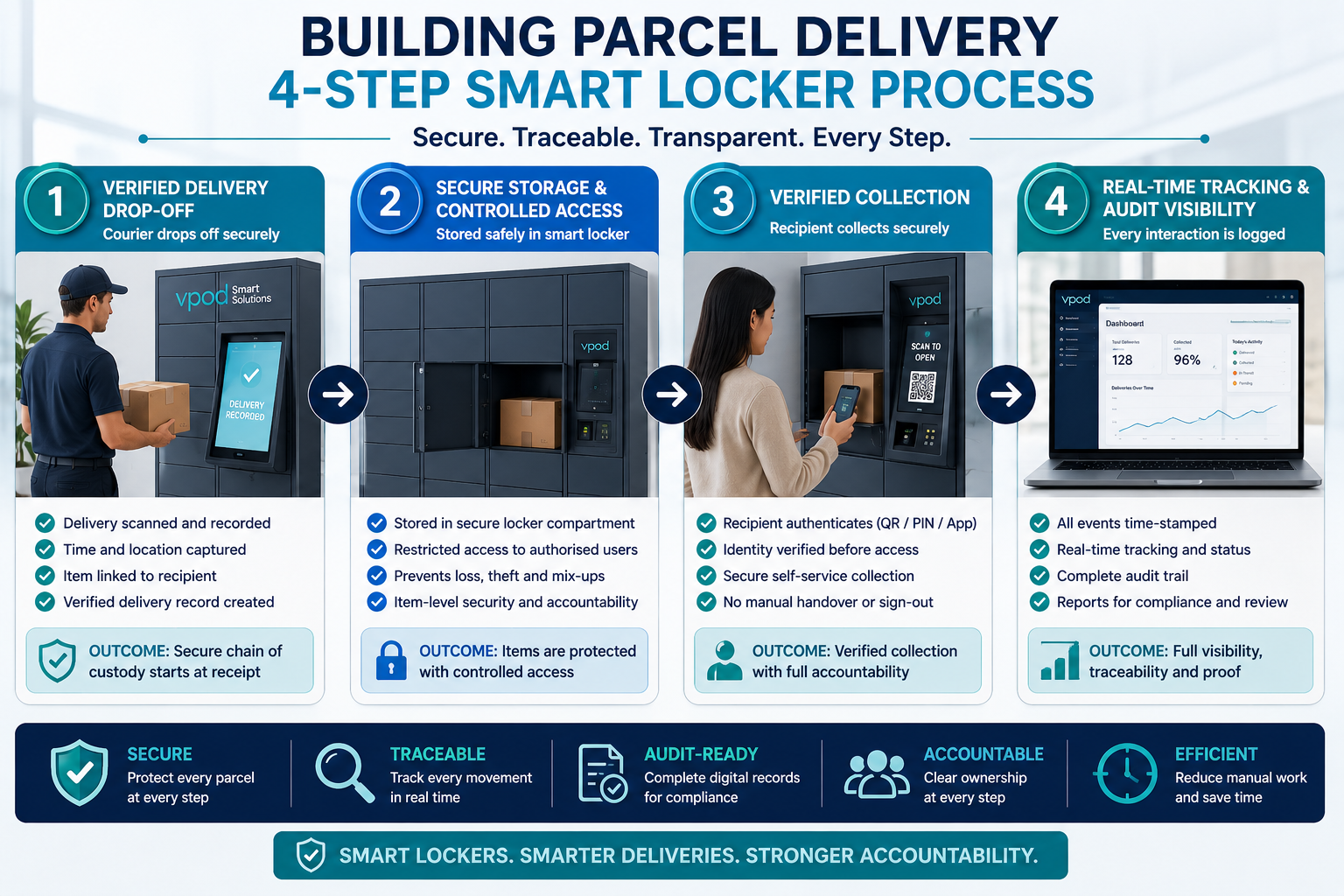
Traditional Delivery Staffing vs Smart Locker Flow Management





Real Operational Results: Reducing Delivery Staffing Costs at Scale
Skyscanner — Reducing Administrative Workload
Skyscanner deployed Vpod smart lockers across offices in Edinburgh, Glasgow, and London to support hybrid working while reducing operational complexity and staff dependency.
Results delivered:
- Reduced workplace administration overhead
- Improved operational efficiency
- Enabled remote locker management
- Reduced dependency on on-site support teams
- Supported scalable workplace operations
Delivery Staffing Cost Management
Facilities Manager / Building Operations Manager
Facilities Manager
Areas of Responsibility
- Parcel and delivery operations
- Reception and mailroom management
- Staff allocation and workload management
- Operational efficiency
- Space utilisation
- Delivery processing during peak periods
Areas of Concern
- Rising delivery staffing costs
- Reception bottlenecks
- Increasing parcel volumes
- Labour-intensive workflows
- Limited operational scalability
- Growing operational pressure on teams
Pain Points
- Staff overwhelmed by parcel handling
- Manual processing slowing operations
- High labour costs during peak delivery periods
- Constant interruptions at reception
- Difficulty scaling operations efficiently
- Increasing workload without automation
Facilities Manager
Areas of Responsibility
- Parcel and delivery management
- Reception and mailroom operations
- Smart locker and storage infrastructure
- Building workflow efficiency
- Occupant and tenant experience
- Delivery chain of custody
- Parcel storage capacity management
- Operational scalability
- Space utilisation
- Security and access control
- Service performance monitoring
- Vendor and courier coordination
Areas of Concern
- Increasing parcel delivery volumes
- Reception congestion and bottlenecks
- Overflowing parcel storage areas
- Uncontrolled parcel access
- Lost or misplaced deliveries
- Staff workload and operational pressure
- Fire safety and blocked walkways
- Poor visibility across parcel movement
- Delivery delays and complaints
- Inefficient manual handling processes
- Scaling operations without increasing headcount
- Maintaining security and accountability at scale
Pain Points
- Reception teams overwhelmed by deliveries
- Parcels overflowing into shared spaces
- Staff interrupted constantly by collections
- Manual logging slowing delivery processing
- Time spent searching for missing parcels
- No real-time tracking visibility
- Long collection queues at peak times
- Shared parcel rooms creating security risks
- Difficulty managing high delivery volume efficiently
- Complaints from residents, employees, or tenants
- Rising operational costs linked to parcel handling
- Manual systems becoming unsustainable at scale