







What Are Luggage Storage Staffing Costs?
Luggage storage staffing costs include all labour required to:
- Receive and tag bags
- Transport luggage to storage
- Organise storage areas
- Retrieve bags on request
- Manage queues and guest interactions
- Resolve issues and lost items
This applies across:
- Hotels and resorts
- Hostels and aparthotels
- High-volume city properties
- Event-driven hospitality environments
Why Staffing Costs Increase at Scale
1. Labour Scales Directly With Volume
Manual luggage systems require:
- One staff interaction per guest
- Physical handling of each bag
As volume increases:
- More staff are required
- More hours are needed
- Costs rise proportionally
More bags = more labour = higher cost
2. Peak periods Force Over Staffing
Hotels experience intense luggage peaks:
- Morning check-outs
- Early arrivals
- Group movements
To manage this, hotels must:
- Staff for peak demand
- Maintain excess capacity
This results in:
- Idle staff during off-peak periods
- Poor labour utilisation
Manual Luggage Storage Vs Self-Service Lockers
3. Double Handling Doubles Labour Demand
Each bag is handled at least twice:
- Drop-off
- Retrieval
This creates:
- Two staff interactions per guest
- Increased workload
- Higher cost per bag
/pain-points/hotel-luggage-storage-problems/
/pain-points/hotel-luggage-storage-queue/
/pain-points/hotel-bag-storage-inefficiency-scale/
4. Retrieval Is Labour-Intensive
Collection requires:
- Searching for specific bags
- Navigating disorganised storage
- Verifying ownership
As storage fills:
- Retrieval time increases
- Staff productivity decreases
5. Queues Create Additional Staffing Pressure
When queues form:
- Additional staff are deployed
- Supervisors are required
- Front desk teams are pulled in
This creates a cycle:
More demand → more queues → more staff → higher cost
Why Hotel Storage Overflow Breaks Operations at Scale
6. Error Handling Adds Hidden Labour Costs
Manual systems lead to:
- Lost or misplaced bags
- Incorrect handovers
- Guest complaints
This requires:
- Investigation time
- Management involvement
- Additional staff effort

The Hidden Cost Multipliers
Labour Costs Increase Faster Than Demand
Operational Complexity Expands
Time Demands Continue to Grow
Resources Shift Away from Guest Services
Why Guest Experience Is Changing Hotel Luggage Storage
Where Luggage Storage Staffing Costs Become a Challenge
High-Occupancy Hotels
Hotels with high guest turnover often experience increased luggage handling requirements throughout the day, placing additional pressure on operations teams.
City-Centre and Business Hotels
Early arrivals, late departures, and short-stay guests create frequent luggage storage requests that require ongoing staff involvement.
Group and Event-Driven Properties
Large group arrivals and departures can generate significant spikes in luggage activity, increasing operational complexity and resource requirements.
Tourist and Leisure Destinations
Properties serving leisure travellers often manage higher luggage volumes, particularly when guests arrive before check-in or remain after check-out.
Transport-Connected Hotels
Hotels near airports, train stations, and travel hubs frequently support guests who need temporary luggage storage, increasing demand throughout the day.
High-Footfall Hospitality Environments
Hotels processing large numbers of guests must manage luggage efficiently while maintaining service levels and controlling operational costs.
Why Traditional Luggage Storage Systems Increase Staffing Costs
Manual Luggage Handling Requires More Labour
Traditional luggage storage depends on staff to receive, move, store, organise, and retrieve every bag. As luggage volumes increase, labour requirements grow alongside demand, making hotel luggage operations more resource-intensive and expensive to manage.
Peak Demand Creates Staffing Pressure
Check-in, check-out, early arrivals, and group bookings create concentrated luggage activity throughout the day. Hotels often need additional staff to manage these demand spikes, increasing operational costs and reducing efficiency during quieter periods.
Retrieval Processes Reduce Productivity
Locating, verifying, and returning luggage can be time-intensive, particularly during busy periods. As storage volumes increase, retrieval times grow, queues become more common, and valuable staff resources are diverted away from guest-facing activities.
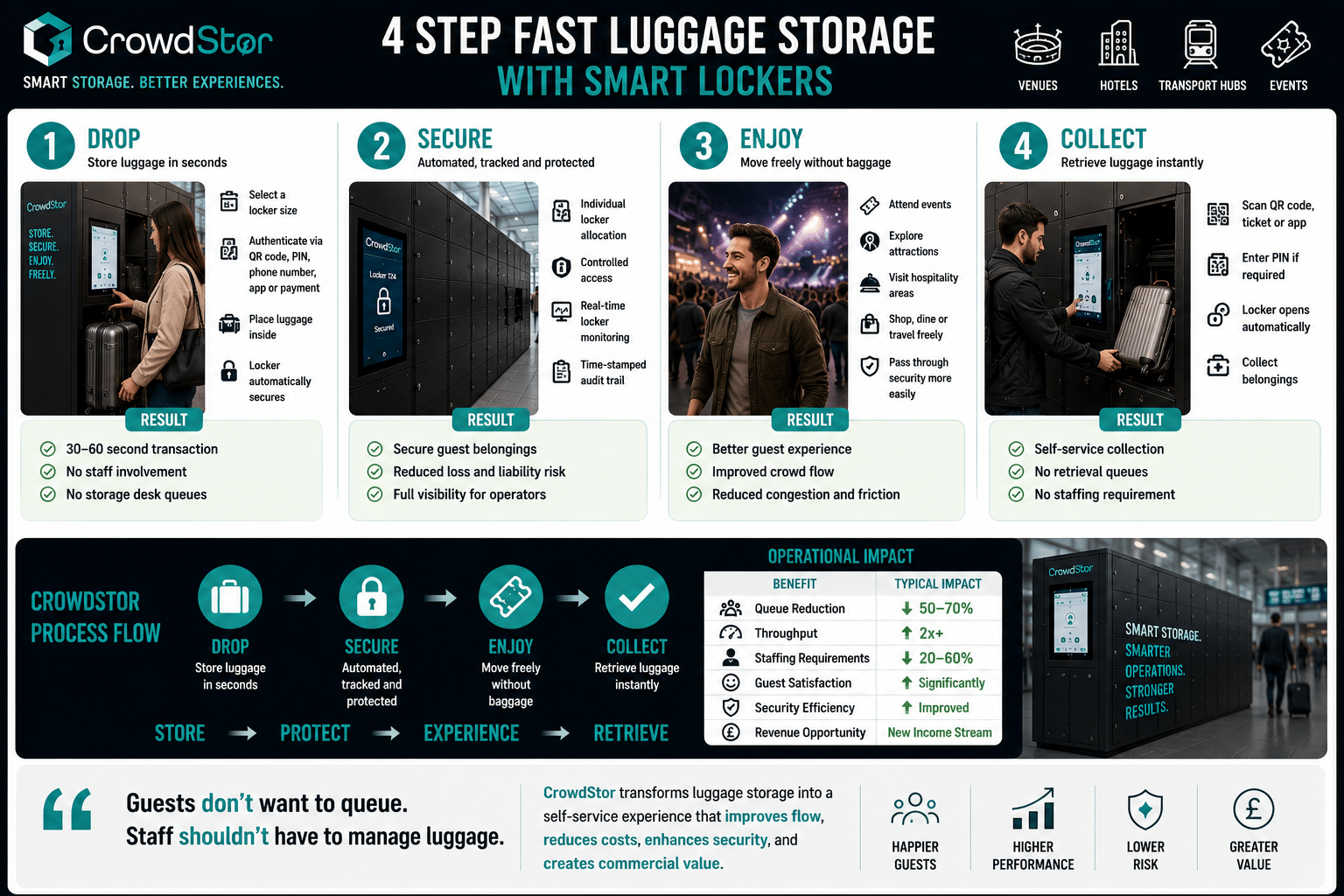
Smart Luggage Lockers Reduce Labour Dependency
Self-service luggage lockers allow guests to store and retrieve luggage independently. This reduces manual handling, lowers staffing requirements, and helps hotels improve operational efficiency without increasing labour costs.
Benefits include:
- Reduced luggage handling workload
- Lower staffing costs
- Faster luggage retrieval
- Improved operational efficiency
- More scalable hotel luggage storage
4 Step Fast Smart Locker Process
Traditional Luggage Storage vs Smart Luggage Lockers





Case Study: Ziggo Dome & VPOD
Managing Hotel Storage Overflow at Scale
Who Is Affected by Rising Luggage Storage Staffing Costs?
Hotel Operations Managers & Front Desk & Guest Services Teams
Hotel Operations Managers
Key Challenges
- Rising luggage storage staffing costs
- Labour-intensive luggage handling processes
- Staffing shortages during peak periods
- Maintaining operational efficiency at scale
- Controlling hotel labour costs as demand grows
Operational Pain Points
- Increasing staffing requirements
- Higher operational expenditure
- Difficulty managing peak luggage volumes
- Reduced labour utilisation during off-peak periods
- Pressure to improve efficiency without increasing headcount