Trusted by these customers
- 200+ smart locker systems installed in hotel and hospitality environments
- Over 380,000 guest uses annually across deployed locations
- Active across 25+ countries in high-footfall environments
Smart Luggage Storage Without Front-Desk Bottlenecks
Common Hotel Luggage Storage Challenges in Modern Hotels
Hotel luggage storage challenges are a common issue in modern hotel environments. Hotels operate with fixed check-in and check-out windows, high guest turnover, and constant movement — making luggage storage a critical operational pressure point.
When storage systems rely on manual handling, hotel baggage storage issues quickly scale into front-desk congestion, security risks, and operational disruption.
Hotel Luggage Storage Before Check-In and After Check-Out
Guests frequently arrive before rooms are ready and depart after check-out, creating continuous demand for short-term luggage storage. Without structured systems, bags accumulate at reception, increasing congestion and slowing guest processing during peak periods.
→ Hotel luggage storage before check-in
→ Luggage storage after checkout hotel
→ Luggage lockers for hotels
Front Desk Congestion Caused by Luggage Handling
Manual luggage handling places direct pressure on front desk teams. Each bag requires tagging, movement, and retrieval, interrupting core guest services and increasing queue times during busy periods.
→ Reduce front-desk congestion caused by luggage
→ Hotel storage solutions for operations directors
→ Smart luggage lockers for hotels
→ Compare manual luggage storage vs self-service lockers
Manual Luggage Rooms and Lost Item Risk
Traditional luggage rooms rely on manual processes and staff oversight, creating risk as volume increases. Misplaced items, limited visibility, and shared access environments lead to disputes and reduced accountability.
→ Hotel luggage room problems and risks
→ Manual baggage handling issues in hotels
→ Secure luggage lockers with audit trails
→ Compare hotel luggage room vs smart lockers
Group Arrivals and Hotel Storage Bottlenecks
Group check-ins, conferences, and tours create concentrated luggage demand within short timeframes. Without scalable systems, reception teams become overwhelmed, storage areas reach capacity, and guest flow slows significantly.
→ Hotel group check-in luggage challenges
→ Managing peak hotel arrivals and departures
→ Scalable luggage locker systems for hotels
Limited Space and Front-of-House Storage Constraints
Many hotels lack dedicated storage areas, forcing luggage into reception zones and guest-facing spaces. This creates clutter, restricts movement, and negatively impacts the overall guest experience.
→ Hotel storage space constraints
→ Front-of-house congestion in hotels
→ Space-efficient luggage locker systems
Hotel Luggage Lockers vs Traditional Luggage Rooms
Where Hotel Luggage Storage Challenges Break Down Operations
These hotel luggage storage challenges typically appear at multiple points across the guest journey, particularly in busy, high-turnover environments where manual processes cannot scale efficiently. These pressure points directly impact front-desk performance, guest experience, and operational flow.
Luggage Storage Before Check-In and After Check-Out
Hotel luggage storage before check-in and after check-out creates constant demand outside standard room access times. Early arrivals and late departures mean guests rely on temporary storage to continue their journey.
When managed manually:
- Reception queues increase during peak check-in and check-out windows
- Staff are required to tag, move, and track luggage
- Storage areas quickly become disorganised
Explore:
- Hotel luggage storage challenges
- Luggage lockers for hotels
Guest Belongings During Short City Visits
City-break and business travellers frequently require short-term hotel luggage storage while attending meetings, exploring the city, or waiting for onward travel.
Without structured storage:
- Guests return to reception multiple times
- Front desk teams handle repeated storage requests
- Guest experience becomes inconsistent and dependent on staff availability
Explore:
- Hotel operations and guest flow
- Luggage lockers for hotels
High-Footfall Urban Hotel Locations
Centrally located hotels experience continuous guest movement throughout the day, increasing pressure on both storage systems and front-of-house teams.
In these environments:
- Storage demand is constant, not peak-based
- Reception areas become congested with luggage handling
- Guest flow is disrupted by operational tasks
Explore:
- Hotel luggage storage challenges
- Improve hotel guest flow
Group Arrivals and Departures
Tour groups, conferences, and events introduce concentrated luggage volumes within short timeframes, creating significant operational strain.
Without scalable storage systems:
- Front desk teams become overwhelmed
- Luggage accumulates in guest-facing areas
- Check-in and check-out processes slow down significantly
Explore:
- Hotel luggage storage challenges
- Scalable luggage locker systems
Limited Front-of-House Space
Many hotels operate with limited storage capacity, particularly in urban or space-constrained environments.
This results in:
- Luggage being stored in reception or public areas
- Reduced space for guest movement
- Increased safety and operational risk
Explore:
- Hotel storage space challenges
- Space-efficient luggage lockers
Staff-Managed Storage Creating Operational Strain
Manual hotel luggage storage requires ongoing staff involvement, particularly during busy periods.
This creates:
- Continuous interruptions for front desk teams
- Increased risk of delays and service inconsistency
- Higher likelihood of lost, misplaced, or disputed items
As demand increases, these manual processes become a core operational bottleneck.
Explore:
- Reduce front-desk congestion
- Automated luggage locker systems
- → Compare hotel concierge storage vs lockers
How Hotel Luggage Storage Fits Into Hotel Operations
Hotel Luggage Storage Should Support Guest Flow — Not Burden Reception
In modern hotel environments, hotel luggage storage plays a critical role in managing guest flow around check-in and check-out. When handled manually, it becomes an additional front-desk responsibility that slows service and increases operational pressure.
Managing Early Arrivals and Late Departures
Hotel luggage storage before check-in and after check-out supports guests arriving early or departing late — one of the most consistent operational pressures in hospitality.
Without structured hotel luggage storage systems:
- Reception teams manage high volumes of guest belongings
- Check-in and check-out queues increase
- Guest flow becomes inconsistent during peak periods
Reducing Front-Desk Congestion Caused by Luggage Handling
Manual hotel luggage storage directly impacts front-desk performance. Every bag handled adds time, complexity, and interruption to core guest services.
By removing luggage handling from reception:
- Front-desk congestion is reduced
- Staff can focus on guest service rather than storage tasks
- Check-in and check-out processes become faster and more predictable
Protecting Guest Experience During Peak and Group Movements
During peak periods, group arrivals, and high guest turnover, hotel luggage storage must operate efficiently to maintain a consistent guest experience.
Without structured storage:
- Luggage handling delays check-in and check-out
- Guest-facing areas become cluttered
- Service quality declines during busy periods
Structured, self-service hotel luggage storage ensures predictable operations while maintaining a professional and seamless guest experience.
Hotel Luggage Storage Workflow: Traditional vs Smart Lockers
This comparison shows how hotel luggage storage workflows shift from manual, staff-dependent processes to structured, self-service systems using smart luggage lockers.
Traditional Hotel Luggage Storage Workflow
- Guest arrives before check-in
- Room is not ready
- Guest asks reception to store luggage
- Staff tag and move bags to storage
- Guest returns later
- Reception retrieves luggage
Operational Challenges
- Reception queues during peak check-in periods
- Staff diverted from core guest service tasks
- Risk of misplaced or incorrectly tagged luggage
- Limited access outside reception hours
- Manual hotel luggage storage that does not scale during peak demand
→ Compare manual luggage storage vs self-service lockers
Smart Luggage Locker Workflow
- Guest arrives before check-in
- Room is not ready
- Guest stores luggage in a smart luggage locker
- System generates a secure access code
- Guest explores or leaves the hotel
- Guest returns later
- Guest retrieves luggage directly from locker
Operational Advantages
- Removes luggage handling from reception teams
- Provides 24/7 hotel luggage storage access
- Reduces front-desk congestion during peak periods
- Improves security with full audit trails and traceability
- Enables scalable, self-service hotel luggage storage
- Supports consistent guest flow without increasing staff workload
Explore:
- Reduce front-desk congestion caused by luggage
- Hotel luggage lockers →
- Improve hotel guest flow
Hotel Locker Case Studies & Measurable Results
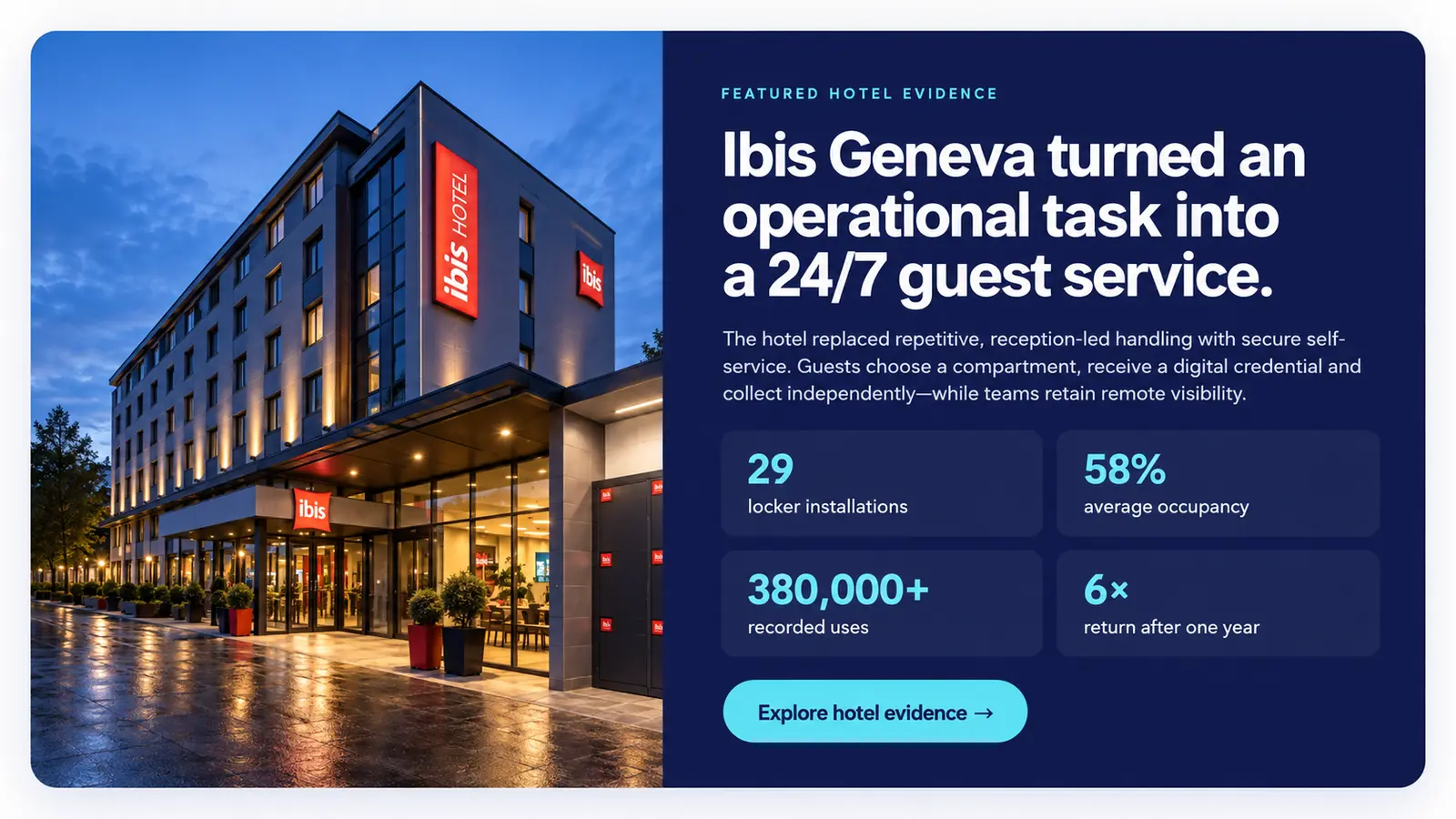
Ibis Geneva – Managing Early Arrivals and Late Departures
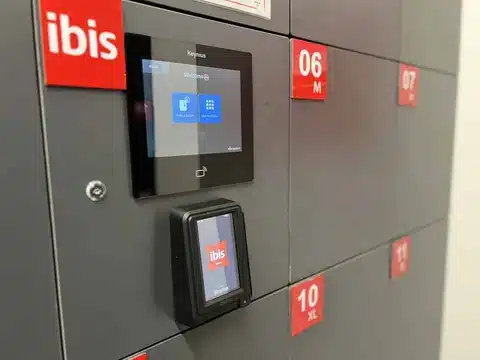
A high-footfall urban hotel, Ibis Geneva faced ongoing pressure from hotel luggage storage before check-in and after check-out. Manual luggage handling was creating queues, increasing staff workload, and disrupting front-desk operations during peak periods.
Challenge
- Reception queues during peak check-in periods
- Staff managing manual hotel luggage storage
- Delays caused by early arrivals and late departures
Solution
The hotel replaced traditional luggage rooms with self-service hotel luggage lockers, enabling guests to store belongings independently without staff involvement.
→ Explore hotel luggage lockers
→ Compare hotel luggage room vs smart lockers
Results
- Improved front-desk efficiency and guest flow
- Reduced staff intervention in luggage handling
- 6× ROI within 12 months
- 380,000+ guest uses annually
- New revenue stream from paid luggage storage
→ Compare free storage vs paid locker systems
Premier Inn Cologne – 24/7 Hotel Luggage Storage at Scale
Premier Inn Cologne required a scalable solution for hotel luggage storage to reduce reception congestion and support guests arriving outside standard check-in times.
Challenge
- Front-desk congestion caused by manual luggage handling
- Limited access to luggage storage outside reception hours
- High demand from early arrivals and late departures
→ Reduce front-desk congestion
Solution
The hotel implemented smart luggage lockers with multilingual access and integrated payment, providing 24/7 hotel luggage storage without staff dependency.
→ See smart luggage locker solutions → /locker-solutions/solutions/luggage-lockers/
Results
- Reduced reception workload and congestion
- Enabled 24/7 self-service luggage storage
- Improved guest experience during arrival and departure
- 6× ROI within the first year
Hotel Locker Solutions for Luggage Storage and Guest Operations
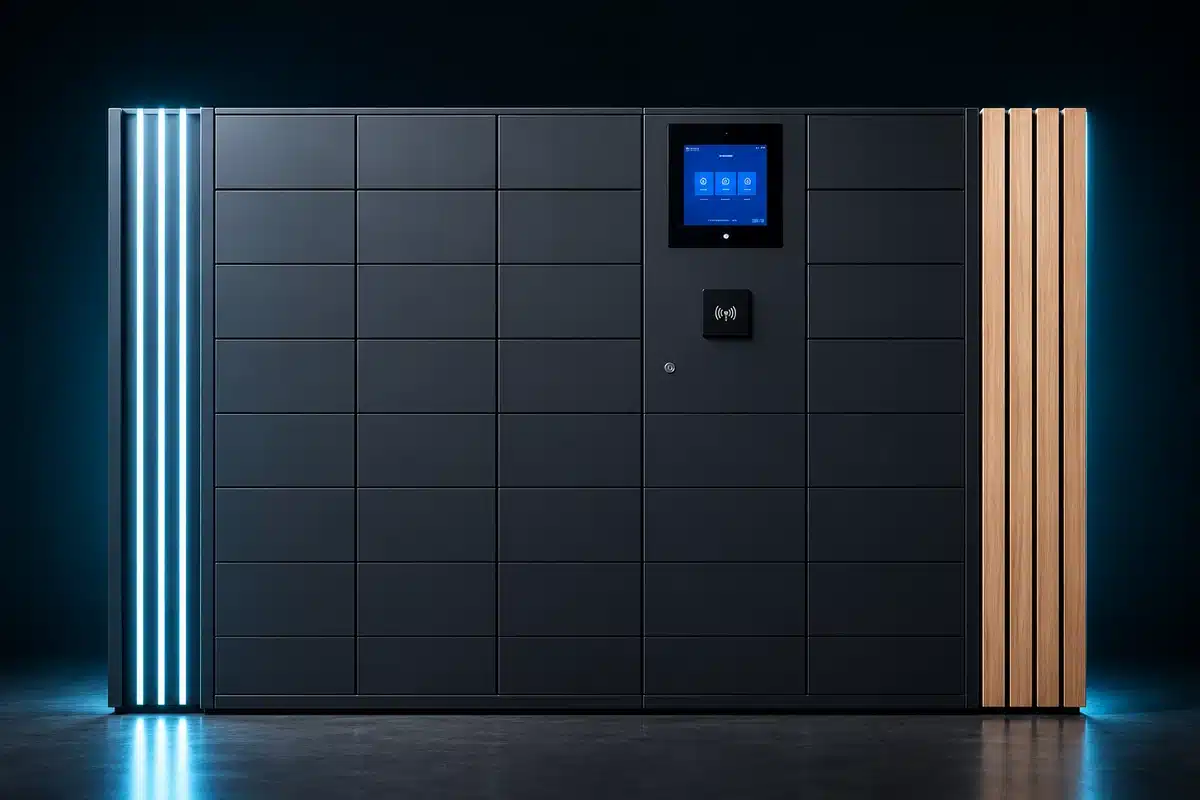
Luggage lockers for hotels are designed to replace manual luggage rooms and support hotel luggage storage before check-in and after check-out. By enabling secure, self-service storage, they remove operational pressure from reception teams and improve guest flow.
They enable hotels to:
- Reduce front-desk congestion caused by luggage handling
- Eliminate manual tagging and tracking of guest belongings
- Provide 24/7 hotel luggage storage without staff involvement
- Improve security with controlled access and audit trails
- Support high guest turnover and peak arrival periods
→ Explore luggage lockers for hotels
Parcel Lockers for Guest Deliveries and Hotel Operations
Parcel lockers for hotels are used to manage inbound guest deliveries, courier drop-offs, and internal logistics without involving reception teams. As delivery volumes increase, they provide a structured alternative to manual parcel handling.
They enable hotels to:
- Remove parcel handling from front-desk workflows
- Provide secure, trackable delivery and collection
- Improve visibility across guest deliveries and operations
- Reduce disruption to reception and guest-facing areas
- Support consistent processes across multiple locations
→ Explore parcel lockers for hotels
Why Hotels Use Locker-Based Storage Systems
Hotels implement smart locker systems to improve both guest experience and operational performance as storage demand increases.
Across hotel environments, lockers consistently deliver:
- Reduced front-desk congestion during peak check-in and check-out
- Faster, more predictable hotel luggage storage workflows
- Lower labour dependency for luggage and parcel handling
- Improved guest satisfaction during arrival and departure
- Scalable storage systems that adapt to occupancy and demand
By replacing manual luggage storage with self-service hotel locker systems, hotels can standardise operations, reduce risk, and deliver a more efficient, consistent guest experience.
→ Compare capex vs opex locker model
Who Hotel Locker Solutions Are Designed For
Hotel Operators
Hotel operators are responsible for protecting overall guest experience while maintaining operational efficiency across the property. As hotel luggage storage demand increases, manual processes create risk around guest belongings and service consistency.
Pain:
Manual hotel luggage storage creates front-desk congestion, increases handling risk, and impacts guest satisfaction during arrival and departure.
Outcome:
Improved guest experience, reduced operational friction, and secure, scalable hotel luggage storage systems that protect brand reputation.
Explore:
Hotel luggage lockers for operators
Improve hotel guest experience
Operations Directors
Operations directors manage hotel guest flow, front-desk performance, and arrival and departure processes across single or multi-site properties. As volumes increase, manual luggage handling becomes a key operational bottleneck.
Pain:
Front-desk congestion caused by luggage handling, inconsistent processes across locations, and reduced efficiency during peak check-in and check-out periods.
Outcome:
Reduced front-desk pressure, faster guest flow, and standardised hotel luggage storage workflows across all properties.
Explore:
Hotel luggage lockers for operations directors
Reduce front-desk congestion
Facilities Managers
Facilities managers are responsible for maintaining safe, organised environments while managing space constraints and storage infrastructure across hotel properties.
Pain:
Cluttered front-of-house areas, unmanaged luggage storage, and increased maintenance burden caused by manual storage systems.
Outcome:
Optimised space usage, reduced operational risk, and structured hotel storage systems that keep guest areas clear and controlled.
Explore:
Luggage lockers for facilities managers
Solve hotel storage space challenges