


What Is Chain of Custody in Delivery?
Chain of custody refers to the documented journey of an item, including:
- Who received it
- Where it was stored
- Who accessed it
- When it was collected
It ensures:
- Accountability at every step
- Traceability of every movement
- Security of every item
This is critical in:
- Workplace deliveries → solutions/workplace-smart-locker
- Delivery → locker-solutions/delivery
- Events and venues → solutions/event-smart-lockers
- Logistics→solution/logistics-smart-lockers
Why Chain of Custody Fails at Scale
1. Too Many Hand-Off Points
At scale, deliveries pass through multiple stages:
- Courier drop-off
- Reception or intake
- Internal handling
- Storage
- Final collection
Each hand-off introduces risk:
- No record of transfer
- No clear ownership
- No accountability
2. Manual Logging Is Inconsistent
Most organisations rely on:
- Paper logs
- Spreadsheets
- Manual entry systems
At scale, this leads to:
- Missing entries
- Incorrect data
- Incomplete records
If custody is not recorded automatically, it is not reliable.
3. No Verified Handover Process
In many environments:
- Packages are left at reception
- Items are handed over without ID verification
- Staff sign on behalf of others
This creates:
- Unverified custody
- Disputes over responsibility
- Increased risk of loss
4. Shared Storage Creates Exposure
Deliveries are often stored in:
- Open parcel rooms
- Back offices
- Shared storage areas
This leads to:
- Uncontrolled access
- Items being moved without record
- Increased risk of theft or error
5. Lack of Real-Time Tracking
Without real-time systems:
- Item location is unclear
- Status is unknown
- Issues are discovered too late
This results in:
- Time spent searching
- Delayed resolution
- Operational inefficiency
→smart locker integrations and tracking tools
6. Volume Breaks Process Discipline
As delivery volume increases:
- Staff prioritise speed over process
- Steps are skipped
- Controls weaken
This leads to:
- Gaps in custody
- Lost accountability
- Increased error rates

The Hidden Risks of Broken Chain of Custody
Security Risk
Compliance Risk
Financial Loss
Customer / Employee Experience
Operational Inefficiency Risk
Poor delivery chain of custody creates operational inefficiencies across workplaces, parcel rooms, logistics hubs, and shared storage environments.
Without real-time delivery visibility:
- Staff spend time searching for missing items
- Delivery disputes take longer to resolve
- Manual tracking increases administrative workload
- Retrieval delays slow operational workflows
- Productivity decreases across teams
As delivery volume increases, operational inefficiencies become harder to control and manage at scale.
Explore parcel locker solutions:solutions-parcel-lockers
Delivery Security Risk
Without secure delivery chain of custody systems:
- Deliveries can be accessed by unauthorised users
- Sensitive items become exposed
- Shared storage increases delivery risk
- Accountability gaps become harder to trace
- Missing parcel incidents become more common
Maintaining secure, verified delivery access becomes increasingly difficult in high-volume environments using manual tracking systems.
Compare manual vs automated delivery workflows:manual-security-handling-vs-automated-storage-systems
Scalability & Accountability Pressure
As delivery operations grow, manual delivery systems become harder to manage securely and efficiently.
High delivery volume can lead to:
- Increased operational pressure on staff
- More hand-off points
- Reduced tracking visibility
- Slower delivery processing
- Higher risk of accountability failures
Without scalable delivery infrastructure, organisations struggle to maintain secure delivery accountability across growing operations.
Explore integrations and operational tools:integrations
The Core Problem: Accountability Breaks at Scale
The Core Problem: Poor Crowd Flow
Delivery chain of custody failures are not caused by individual mistakes alone. They happen when organisations cannot maintain secure delivery tracking and accountability across high-volume operations.
As delivery volume increases:
- More hand-offs occur
- More people access deliveries
- Tracking becomes inconsistent
- Visibility decreases
- Accountability gaps appear
As operational complexity increases, delivery chain of custody becomes harder to manage across parcel rooms, workplaces, logistics hubs, and shared storage environments.
Why Crowd Safety Risk Breaks Leisure Venues at Scale
Why Perimeter Security Crowd Risk Breaks at Scale | Event Security Flow
Why Crowd Flow Bottlenecks Break Stadiums at Scale (And How to Fix Them)
The Biggest Hidden Driver of Custody Failure: Manual Processes
Across delivery operations, one factor consistently weakens chain of custody:
Manual handling and uncontrolled workflows.
This includes:
- Reception-based parcel handling
- Paper logs and spreadsheets
- Shared parcel rooms
- Unverified handovers
- Manual tracking processes
- Lack of real-time visibility
The more manual the process becomes, the harder it is to maintain secure delivery accountability at scale.
Remove manual gaps…
…and delivery visibility improves.
Smart Locker Delivery Systems
Smart locker systems create a secure, automated chain of custody from delivery receipt to final collection.
Verified Delivery Drop-Off
Every delivery is automatically recorded, time-stamped, and linked to a specific recipient.
Secure Item-Level Storage
Individual locker compartments prevent uncontrolled access and reduce delivery exposure.
Verified Self-Service Collection
Only authorised users can access deliveries through secure authentication methods.
Automated Audit Trails
Every interaction is tracked automatically with real-time visibility and proof of collection.
Real-Time Operational Visibility
Managers can monitor delivery status, investigate issues faster, and maintain operational accountability across high-volume environments.
The Scalable Solution: System-Enforced Chain of Custody
To improve delivery chain of custody, organisations need systems that are:
- Secure
- Controlled
- Traceable
- Scalable
- Designed for real-time visibility
Why Crowd Flow Matters for Leisure Venues
Real Operational Impact
With automated chain of custody systems:
- Delivery accountability improves
- Parcel loss and theft decrease
- Audit visibility increases
- Compliance becomes easier to manage
- Delivery disputes reduce
- Operational efficiency improves
Compare: manual-security-handling-vs-automated-storage-systems
Better Delivery Accountability at Scale
Delivery chain of custody fails when organisations cannot maintain visibility and control across growing delivery operations.
As delivery volume increases:
- More hand-offs occur
- More tracking gaps appear
- More accountability is lost
- More operational risk is created
The solution is not more manual tracking.
It is automated, system-enforced chain of custody designed for scalable delivery operations.
Why Manual Storage Fails at Scale | Smarter Venue Storage Solutions
Delivery Chain of Custody Process
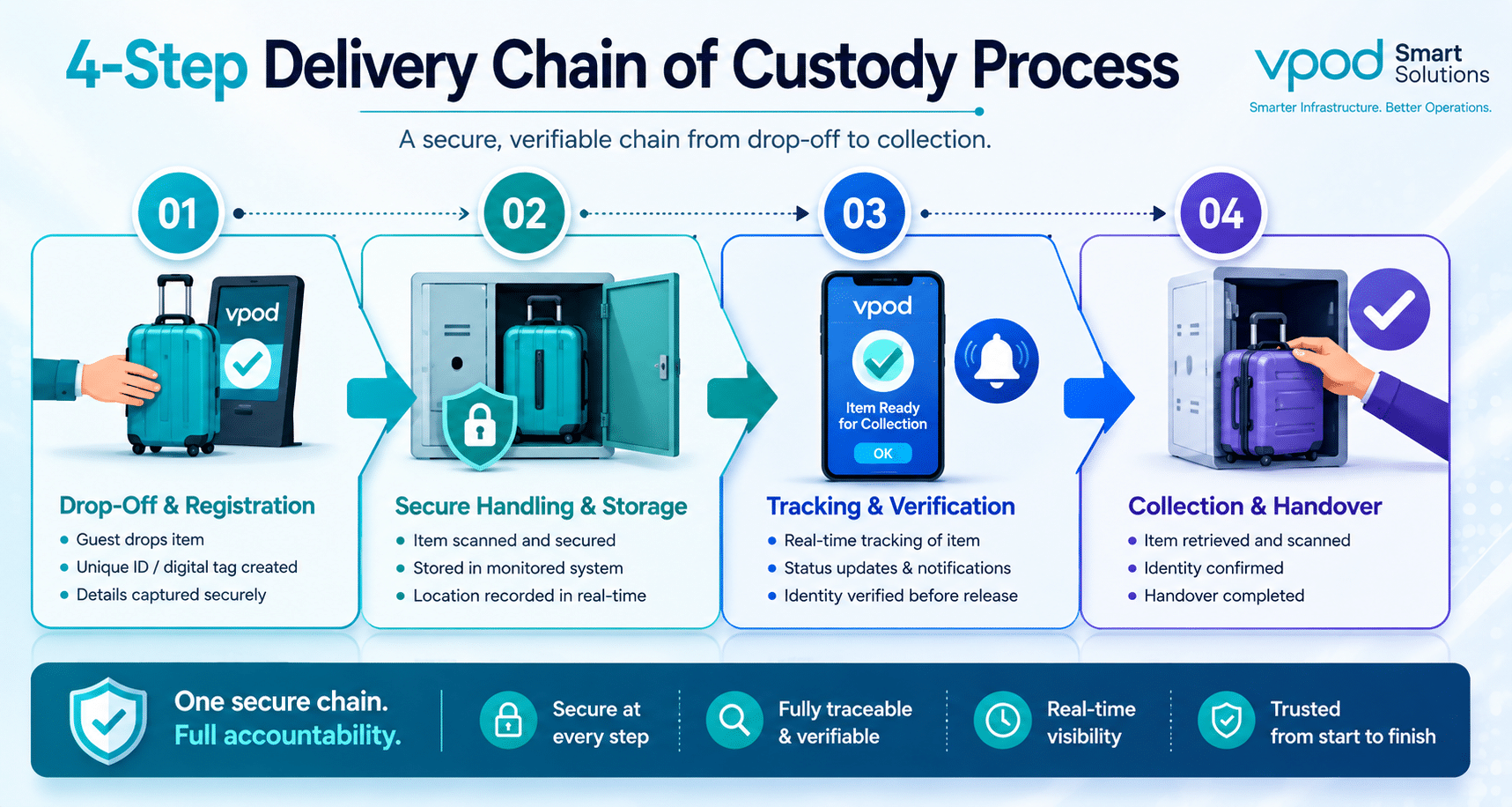
Traditional Delivery Handling vs Smart Locker Chain of Custody





Real-World Delivery Accountability
Leading Footwear Retailer — Click & Collect Transformation
A major UK footwear retailer installed 51 smart locker doors to digitise click-and-collect and returns. The system handles 5,500 orders annually, reduced staff time spent on pickups by 78%, and improved in-store flow while generating actionable usage data.
Related Solutions
Smart Delivery Chain of Custody Management
Designed for Facilities Managers, Operations Teams, and Security & Compliance Leaders
Facilities Manager / Workplace Operations Manager
Areas of Responsibility
- Parcel and delivery management
- Workplace storage operations
- Internal delivery workflows
- Asset tracking and accountability
- Operational efficiency
- Mailroom and parcel room management
Areas of Concern
- Missing deliveries
- Uncontrolled parcel access
- Delivery bottlenecks
- Lack of delivery visibility
- Shared storage security risks
- Managing high delivery volume at scale
Pain Points
- Staff manually handling deliveries
- Lost or misplaced parcels
- No real-time tracking visibility
- Delivery disputes and complaints
- Time spent searching for items
- Inefficient manual logging processes