







What Are Crowd Flow Bottlenecks in Stadiums?
Crowd flow bottlenecks occur when the movement of people is restricted at key points in a venue.
These include:
- Entry gates
- Security checkpoints
- Turnstiles
- Concourse access points
- Food & beverage areas
- Restrooms
- Exit routes
When flow slows at any one of these points, it creates:
- Congestion
- Delays
- Queue buildup
- Safety risks
Why Bottlenecks Get Worse at Scale
1. Movement Is Not Continuous
In stadiums, crowd movement happens in waves, not steady flow:
- Pre-match surge
- Half-time rush
- Full-time exit
Each wave creates intense pressure on infrastructure designed for average usage.
Throughput Is Limited by Design
Every stadium has fixed capacity at key points:
|
Flow Point |
Limiting Factor |
|
Turnstiles |
Scan speed |
|
Security |
Search time |
|
Corridors |
Physical width |
|
Concessions |
Service speed |
The slowest point determines overall flow efficiency.
Manual Staff Storage V Automated Lockers
3. Bottlenecks Cascade
When one area slows down:
- Queues form
- Pressure builds behind
- Overflow spills into adjacent areas
- Entire sections become congested
This is how a single delay at security can affect multiple zones across the stadium.
4. Bags Disrupt Movement Everywhere
Bags don’t just impact entry — they affect the entire stadium:
- Slower security checks
- More space required in seating areas
- Congestion in aisles and walkways
- Increased dwell time at entry
Bags introduce friction at every stage of the visitor journey.
5. Static Infrastructure Meets Dynamic Demand
Stadiums are fixed structures.
But crowd behaviour is unpredictable.
This mismatch leads to:
- Underutilised areas in some zones
- Severe overcrowding in others
- Poor distribution of people

The Hidden Risks of Crowd Flow Bottlenecks
Safety & Compliance Risk
Revenue Loss
Poor Fan Experience
Operational Strain
Why Traditional Stadium Solutions Fail
“Add More Staff”
- Reactive, not preventative
- Expensive
- Limited impact on physical constraints
“Widen Access Points”
- Not always possible in existing infrastructure
- High capital cost
Improve Signage
- Helps distribution
- Does not increase throughput
Stagger Entry Times
- Difficult to enforce
- Limited behavioural impact
The Core Problem: Friction in Movement
Friction Points Cause Issues and Risk
Crowd flow bottlenecks are caused by friction points:
- Security checks
- Bag handling
- Narrow access routes
- Manual processes
At scale:
Even small increases in friction create exponential congestion.
The Biggest Hidden Bottleneck: Bag Handling
Across stadiums globally, one factor consistently disrupts flow:
Bags.
They:
- Slow down entry processing
- Increase space usage
- Create secondary queues
- Reduce movement speed inside the venue
Remove the bag problem…
…and you remove a major source of congestion.
Smart lockers transform the cost model entirely.
The Scalable Solution: Design Flow, Don’t Manage It
The most effective stadiums don’t try to manage congestion.
They design it out of the system.
Pre-Entry Smart Locker Systems
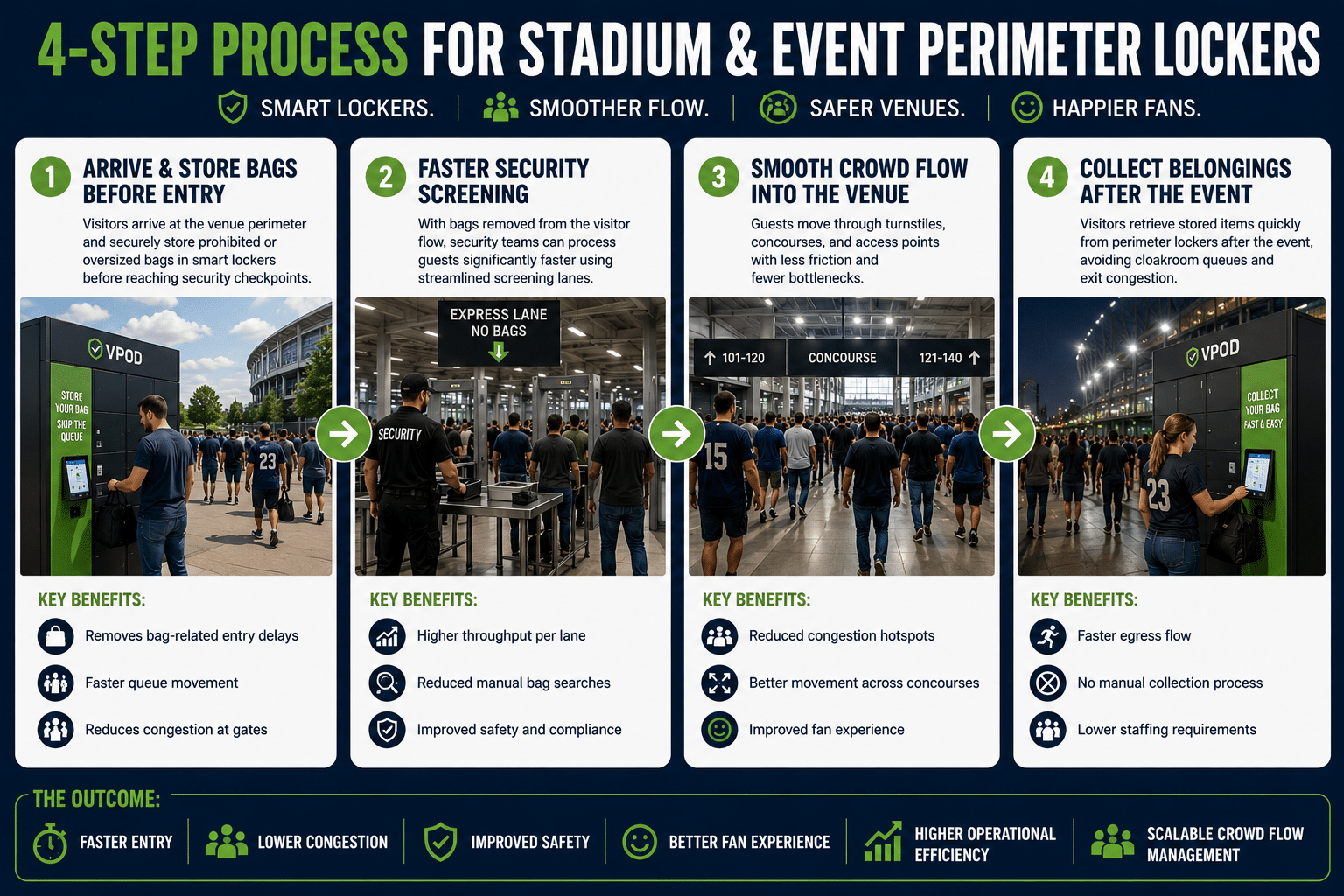
Smart lockers transform flow by:
Removing bags before entry
- Faster security checks
- Increased throughput
Eliminating cloakroom congestion
- No queues
- No manual handling
Enabling distributed storage
- Reduces pressure on key areas
Improving internal movement
- Less congestion in aisles and concourses
Increasing Effective Capacity Without Expanding Infrastructure
By reducing friction:
- More people move through existing spaces
- Flow becomes smoother
- Bottlenecks are minimised
Oprational Impact
With optimised flow systems:
- Entry speeds increase significantly
- Congestion hotspots reduce
- Safety improves
- Revenue per fan increases
- Staff requirements decrease
See: /solutions/event-smart-lockers/
Compare: /cloakrooms-vs-lockers-event-security/
Calculate ROI: /roi-calculator/
The Bottom Line
Stadium bottlenecks are not caused by crowd size.
They are caused by poor flow design.
At scale:
- Movement becomes constrained
- Bottlenecks cascade
- Risk increases
The solution is not to control crowds more tightly.
It’s to remove friction and enable continuous flow.
Event Bag Storage Lockers
Automated Event Perimeter Bag Lockers
1. Faster Crowd Flow & Reduced Queues
Perimeter lockers remove bags before guests reach security checkpoints, dramatically reducing screening times and congestion at entry points.
Benefits:
- Faster venue entry
- Higher throughput
- Reduced bottlenecks and crowd buildup
2. Improved Safety & Security
By eliminating bags from high-density areas, venues reduce security risks, improve visibility, and create safer crowd movement throughout the event.
Benefits:
- Faster and more effective screening
- Lower crowd density risk
- Better compliance with safety regulations
3. Better Fan Experience & Operational Efficiency
Guests enjoy a smoother journey with fewer delays, while venues reduce staffing pressure, cloakroom operations, and manual handling costs.
Benefits:
- Happier attendees
- Lower operational costs
- Scalable event operations without expanding infrastructure
Staffed Cloakroom V Event Perimeter Locker





Proven in High-Turnover Event Environments
Leading Footwear Retailer
- Increased Revenue from Lockers
- Reduced Queuing and Increased Customer Experience
- Reduce Staff Pressure and Costs
- Reduced Risk
Who This Is For
Event Operations Director / Finance Director
Stadium & Venue Operations Directors
Responsible for crowd flow, ingress and egress, staffing efficiency, safety, and operational performance during high-capacity events.
Key Challenges:
- Entry congestion
- Queue management
- Throughput bottlenecks
- Staffing pressure
- Event-day operational risk
Security & Safety Managers
Focused on reducing crowd density, improving screening efficiency, and supporting compliance with modern safety regulations including Martyn’s Law.
Key Challenges:
- Security queue buildup
- Bag screening delays
- Emergency movement restrictions
- High-density crowd areas