Initial investment
What must be spent to design, supply, integrate and launch the system?
Useful for budget approval

We design and deliver integrated systems for streamlined check-ins, secure storage, and enhanced visitor management. Our trusted partner network and focus on sustainability, data security, and customer success drives us to provide the most effective and user-friendly solutions.





We design and deliver integrated systems for streamlined check-ins, secure storage, and enhanced visitor management. Our trusted partner network and focus on sustainability, data security, and customer success drives us to provide the most effective and user-friendly solutions.
We design and deliver integrated systems for streamlined check-ins, secure storage, and enhanced visitor management. Our trusted partner network and focus on sustainability, data security, and customer success drives us to provide the most effective and user-friendly solutions.
Commercial buyer’s guide
Build a defensible smart locker business case by calculating lifetime cost, quantified benefits, payback and return on investment against a clearly defined baseline.
Start with the right question
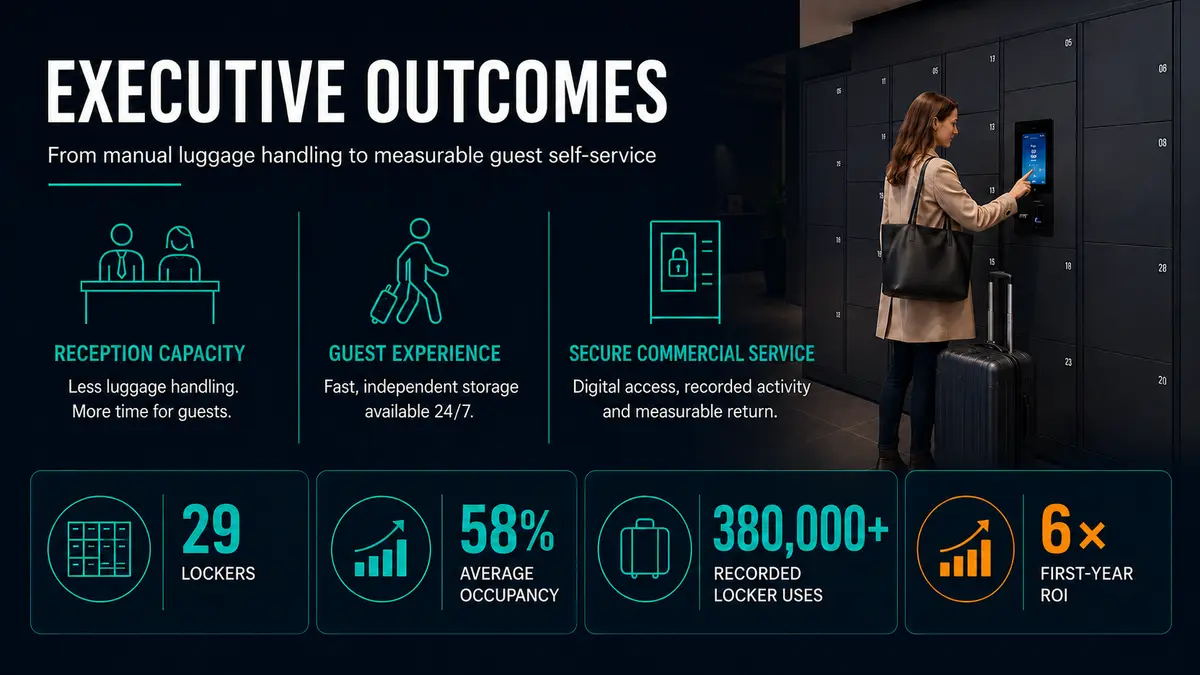
The purchase price is important, but it is not the business case. A buyer also needs to understand the costs of implementation and operation, the value of measurable improvements, the time required to recover the investment and the risks behind the assumptions.
Begin with a defined baseline: the current process, current costs, current demand and current performance. Then compare that baseline with the proposed smart locker system over the same period.
Use the separate guide to understand smart locker cost and pricing factors before building the lifetime model.
Four commercial measures
What must be spent to design, supply, integrate and launch the system?
Useful for budget approvalWhat will the solution cost to acquire, operate, support and change over the evaluation period?
Useful for supplier comparisonHow long will cumulative net benefits take to recover the initial investment?
Useful for cash and risk decisionsWhat return does the project produce relative to the total cost included in the model?
Useful for investment prioritisationCalculation framework
Use the same evaluation period for every supplier and document whether tax, financing, inflation and internal labour are included.
State the period beside every ROI result. A one-year return and a five-year return are not comparable.
Annual net benefit is annual quantified benefit minus annual operating cost. Use a cash-flow model when benefits vary materially by year.
Build the cost side
| Cost group | Typical items to consider | Question to resolve |
|---|---|---|
| Discovery and design | Workflow mapping, site assessment, layout, technical discovery and project design. | Which activities are included before order and after order? |
| Hardware | Cabinets, doors, locks, controller, terminal, readers, accessories and specialist options. | Is the quoted configuration complete for the intended workflow? |
| Implementation | Delivery, assembly, installation, configuration, commissioning, testing and training. | Which site-enabling works remain the buyer’s responsibility? |
| Integration | Technical design, development, licences, testing, deployment and later interface changes. | Does “integration ready” include a live operational connection? |
| Software | Cloud management, workflow modules, users, sites, reporting and notifications. | How is the licence measured and how may it change over time? |
| Support and maintenance | Remote support, service levels, preventative maintenance, call-outs, parts and updates. | What is included, excluded and chargeable after the initial term? |
| Internal ownership | Administration, user support, reporting, governance, training and supplier management. | Which team owns the service and how much time will it require? |
| Change and end of period | Expansion, moves, reconfiguration, replacement, decommissioning and residual value. | What changes are reasonably foreseeable within the evaluation period? |
Build the benefit side
The relevant value drivers change with the application. Select only those that the proposed design can influence and the organisation can measure.
Measure current transactions, handling minutes and loaded labour cost. Apply only the proportion of time that can genuinely be removed or redeployed.
Compare required capacity under fixed allocation with achievable shared use, including any space or fit-out consequence.
Measure service-desk handling, failed collections, urgent deliveries, device downtime and asset recovery where the locker workflow changes them.
Measure receipt, notification, queue, collection and exception time plus any avoided failed handovers or repeat visits.
Use capacity, expected occupancy, transactions, average realised price, seasonality, payment costs and revenue-share terms.
Record auditability, chain of custody and policy improvements separately. Monetise them only where a defensible financial method exists.
Illustrative calculation
The figures below are fictional and demonstrate the method only. They are not Vpod prices, forecasts or expected customer outcomes.
Test the assumptions
Calculate at least a conservative, expected and upside scenario. The conservative case should reduce adoption or savings, delay rollout and include reasonable cost contingency.
A proposal that works only when every assumption performs perfectly is not yet investment-ready.
Lower adoption, slower ramp-up, smaller time saving, higher implementation cost.
Evidence-backed central assumptions with agreed measurement and ownership.
Higher adoption, faster rollout or additional validated workflows and value.
Published deployment evidence
Vpod’s published case study connects guest demand, self-service volume and paid luggage storage with a measured commercial return.
Read the Ibis Geneva case studyThe published results illustrate two different workplace value drivers: administrative workload and storage utilisation.
Read the Skyscanner case study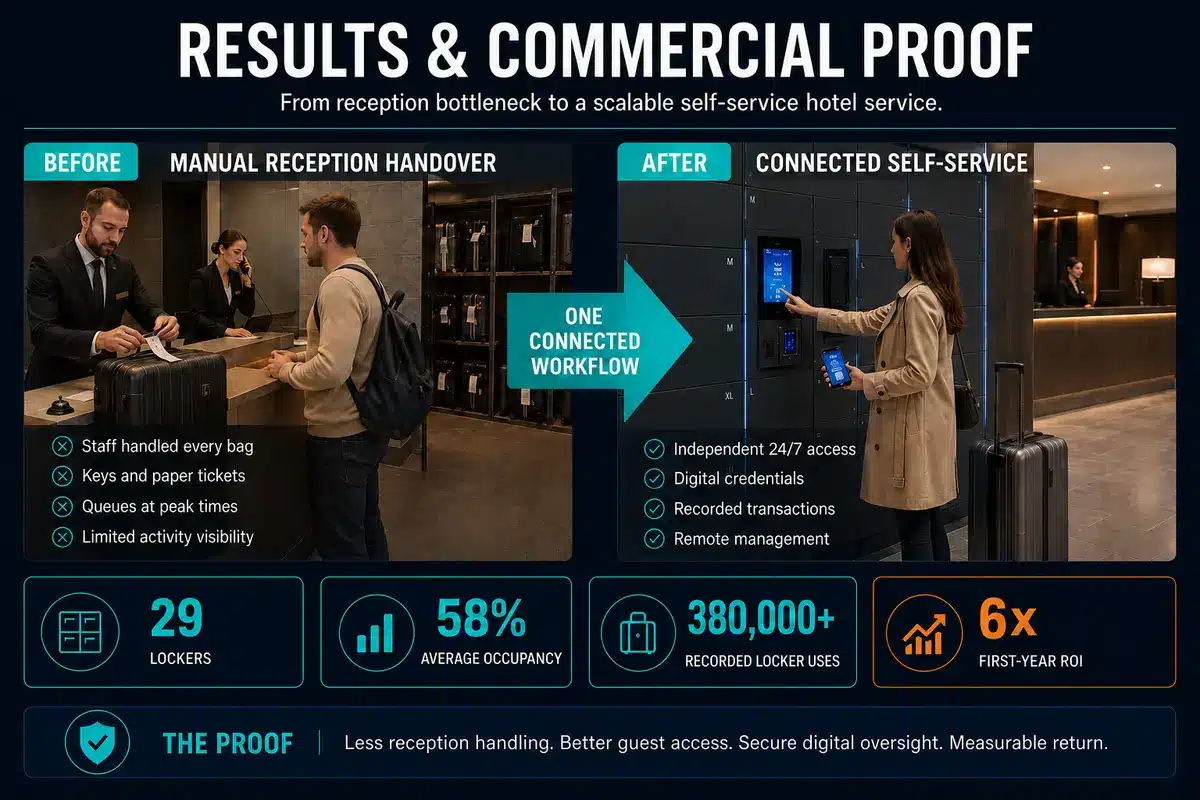
Approval-ready structure
Current process, volume, cost, service level, risks and evidence period.
Users, items, access, allocation, integrations, locations and operating ownership.
Do nothing, improve the manual process, traditional lockers, smart lockers and relevant commercial models.
Initial, recurring, internal, integration, support, change and end-of-period assumptions.
Calculation method, data source, owner, timing and realisation mechanism for every benefit.
ROI, payback and any required NPV or IRR, all labelled with the evaluation period.
Conservative, expected and upside scenarios plus adoption, delivery and dependency risks.
Pre-launch baseline, post-launch KPIs, review dates and accountable benefit owners.
From quotation to investment case
Bring your current process, volumes, labour assumptions, site scope and target outcomes. Vpod can help define an appropriate locker configuration and the operational measures needed for evaluation.