








What Is an Asset Audit Trail?
An asset audit trail is a record of every interaction with an item, including:
- Who stored it
- When it was stored
- Where it was stored
- Who accessed or retrieved it
- When it was collected
This is critical for:
- Security
- Compliance
- Operational control
- Customer accountability
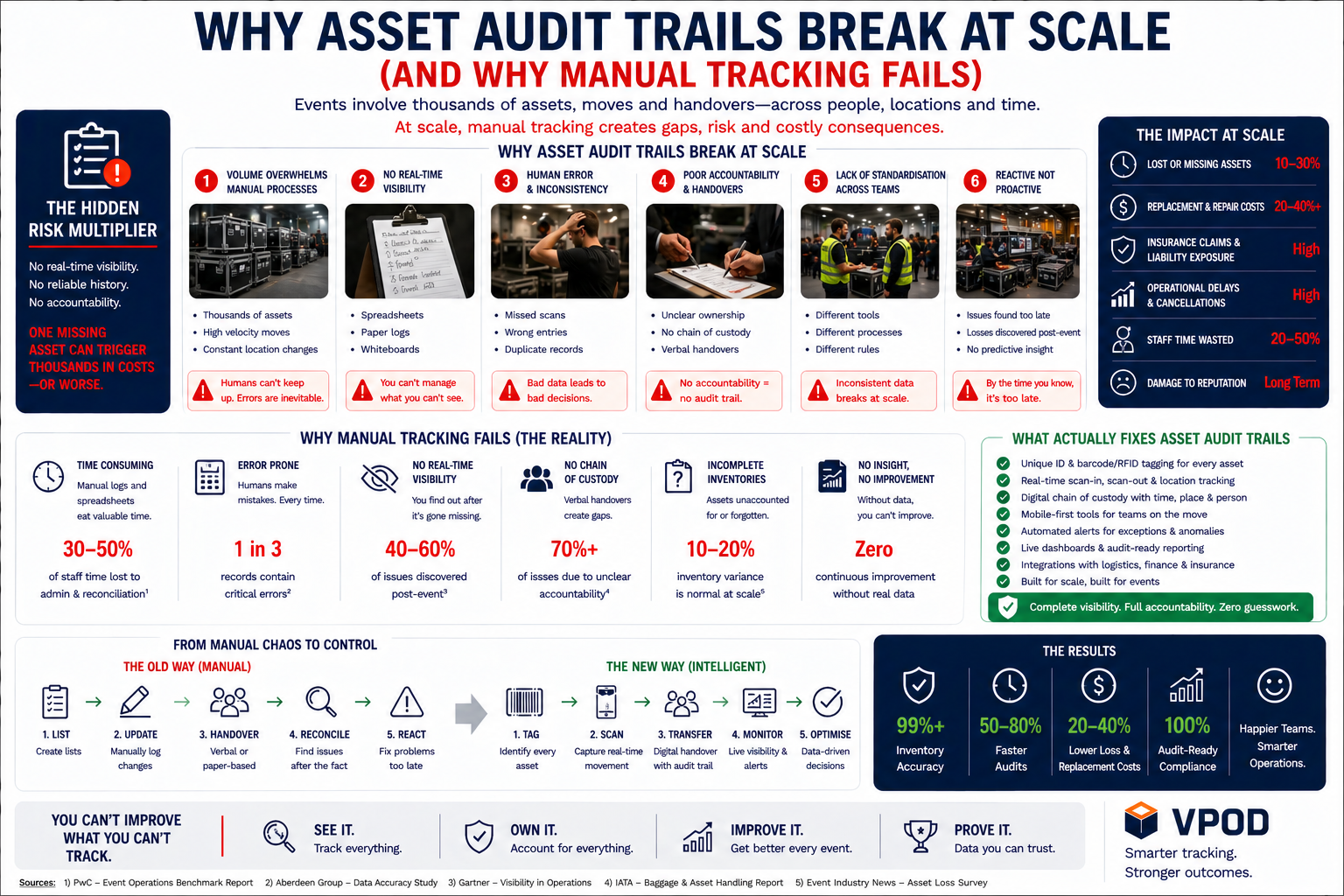
Why Asset Audit Trails Break at Scale
1. Manual Systems Don’t Capture Data Reliably
In many environments, asset tracking relies on:
- Paper logs
- Manual tagging
- Staff memory
- Basic spreadsheets
These methods are:
- Inconsistent
- Incomplete
- Prone to human error
If data is not captured automatically, it is not captured accurately.
2. Volume Overwhelms Tracking Processes
At scale:
- Hundreds or thousands of items move daily
- Peak periods create intense activity
- Staff prioritise speed over accuracy
This leads to:
- Missing records
- Incorrect entries
- Untraceable items
3. Multiple Touchpoints Create Gaps
Assets often pass through several stages:
- Drop-off
- Handling
- Storage
- Retrieval
Each step introduces a risk:
- Data not recorded
- Information lost between teams
- Lack of ownership
4. Staff Dependency Reduces Accountability
Manual audit trails depend on:
- Staff following procedures
- Accurate data entry
- Consistent compliance
At scale, this creates:
- Variability
- Missed steps
- Inconsistent tracking
5. No Real-Time Visibility
Traditional systems provide:
- Delayed updates
- Limited visibility
- No real-time tracking
This means:
- Issues are discovered too late
- Items cannot be located quickly
- Investigations become difficult
6. Data Is Fragmented Across Systems
In many organisations:
- Storage logs
- Security records
- Operational systems
…are not connected.
This leads to:
- Incomplete audit trails
- Data silos
- Lack of end-to-end visibility
Ultimately all six are reasons Why Asset Audit Trails Break at Scale

The Hidden Risks of Missing Audit Trails
Security Risk
Compliance Risk
Financial Loss
Customer Experience Impact
Why Traditional Tracking Solutions Fail
Paper-Based Systems
- Easily lost or damaged
- No real-time access
- Prone to errors
Manual Digital Logs
- Dependent on accurate input
- Time-consuming
- Often incomplete
Barcode or Tagging Without Integration
- Limited visibility
- No end-to-end tracking
- Requires manual scanning discipline
Staff-Led Processes
- Inconsistent execution
- Difficult to enforce at scale
The Core Problem: Lack of Automated Accountability
Audit trails fail because:
They rely on human behaviour instead of system design.
At scale:
- People forget
- Processes are skipped
- Data is incomplete
Without automation, accountability breaks down.
The Scalable Solution: Automated Digital Audit Trails
To achieve reliable tracking, organisations must move to:
- Automated data capture
- Real-time visibility
- System-driven accountability
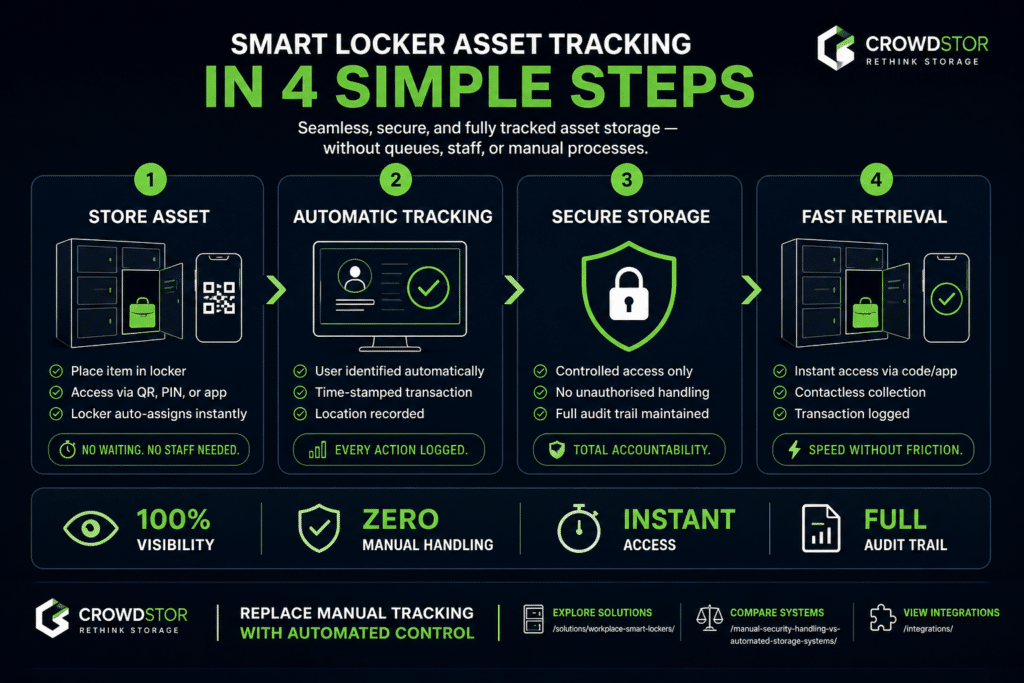
Smart lockers create a complete, automated audit trail for every asset.
Automatic user identification
- Every transaction linked to a user
- No anonymous handling
Time-stamped activity logs
- Storage and retrieval recorded instantly
- Full history available
Secure access control
- Only authorised users can access items
- Digital verification
Real-time visibility
- Know exactly where items are at any time
Centralised data platform
- All activity recorded in one system
- Full reporting and analytics
For more traceable equipment management, explore
asset lockers with digital audit trails
.
Real Operational Impact
With automated audit trails:
- 100% transaction visibility
- Reduced loss and misplacement
- Improved compliance and reporting
- Faster issue resolution
- Enhanced customer trust
See: /solutions/workplace-smart-lockers/
Compare: /manual-security-handling-vs-automated-storage-systems/
The Bottom Line
Asset audit trails don’t fail because organisations don’t care.
They fail because:
Manual systems cannot deliver reliable tracking at scale.
At scale:
- Data becomes incomplete
- Accountability breaks down
- Risk increases
The solution is not better processes.
It’s automated, system-driven tracking.
Smart Asset Lockers
Asset Management Smart Lockers
Total Asset Visibility
Know exactly where every item is, who accessed it, and when — in real time.
Complete Accountability
Every transaction is tracked, time-stamped, and user-linked — eliminating gaps and disputes.
Lower Costs, Higher Efficiency
Reduce manual handling, minimise loss, and scale operations without increasing staff.
Smart Asset Lockers V Manual Storage





Proven in High-Turnover Event Environments
Mars
-
Mars partnered with Vpod to modernise visitor and contractor management across four UK sites, aiming to improve efficiency, experience, and scalability using Vgreet visitor management + smart lockers.
The Challenge
Mars faced typical enterprise-scale issues:
- Manual, admin-heavy processes
- Difficulty maintaining compliance with site requirements
- Inconsistent visitor experience
- Need to support multi-site, multi-region operations
- Requirement for flexible, future-proof technology
Existing systems were not scalable or efficient enough.
The Approach
Rather than deploying a standard solution, Mars and Vpod:
- Designed bespoke workflows per site
- Built solutions aligned to long-term infrastructure strategy
- Focused on scalability and adaptability
- Continued optimisation via “Digital Rocket” use cases
Strong collaboration and tailoring were key differentiators.
Who This Is For
Operations Manager / Security Manager
Operations Manager
Primary Goal: Efficiency, flow, and control
Why they care:
- Needs to know where assets are at all times
- Wants to eliminate delays, searching, and manual handling
- Responsible for smooth day-to-day operations
Pain Points:
- Lost or misplaced items
- Time wasted locating assets
- Inefficient manual processes
Why we think you’ll be interested:
“Know where every asset is. Instantly.”
“Reduce handling. Increase throughput.”
Head of Security
Primary Goal: Control, risk reduction, chain of custody
Why we think you could care:
- Needs full audit trail for every asset
- Must prevent unauthorised access
- Responsible for incident investigation
Pain Points:
- No clear ownership of items
- Broken chain of custody
- Inability to evidence what happened
Why we think it would be useful:
“Every action tracked. Every asset accounted for.”
“Eliminate anonymous handling.”