








What Is Lost Luggage in Hotels?
Lost luggage refers to any situation where a guest’s bag:
- Cannot be located
- Is misplaced within storage
- Is given to the wrong guest
- Is delayed beyond acceptable time
- Is permanently lost
This typically occurs during:
- Pre-check-in storage
- Post-check-out holding
- Group arrivals and departures
Why Luggage Gets Lost at Scale
1. Volume Overwhelms Manual Systems
At peak times:
- Dozens or hundreds of bags are handled
- Staff must process items quickly
- Attention per bag decreases
This leads to:
- Misplacement
- Incorrect tagging
- Loss of control
The more bags you handle, the harder it becomes to track each one.
2. Manual Tagging Is Inherently Unreliable
Most hotels rely on:
- Paper tags
- Ticket matching systems
- Handwritten labels
These systems:
- Can be lost or damaged
- Are easy to mismatch
- Do not prevent incorrect collection
3. Storage Areas Become Disorganised
Luggage is typically stored in:
- Back rooms
- Luggage storage areas
- Unstructured spaces
At scale, this results in:
- Bags stacked or moved frequently
- No fixed location per item
- Increased search time
If a bag doesn’t have a defined location, it will eventually be lost.
4. No Real-Time Visibility
Hotels often lack:
- Tracking systems
- Inventory of stored bags
- Visibility of storage locations
This means:
- Staff don’t know where items are
- Guests must wait while bags are located
- Issues escalate quickly
5. Multiple Hand-Offs Break Accountability
Luggage may be handled by:
- Reception staff
- Porters
- Storage teams
- Different shifts
Each hand-off creates risk:
- No clear ownership
- No tracking of movement
- No accountability
6. Retrieval Is the Highest-Risk Moment
Most losses occur during collection:
- Guests return at peak times
- Staff search under pressure
- Bags are moved or misidentified
This leads to:
- Wrong bag given out
- Delays locating items
- Confusion and disputes

The Hidden Impact of Lost Luggage
Guest Experience Breakdown
Operational Pressure Increases
Financial & Reputation Costs Rise
Security & Liability Risks Grow
Lost Luggage the key issues
The Core Problem: Lack of Visibility and Control
Lost luggage is rarely caused by a single mistake.
It happens when hotels rely on manual luggage handling, paper tagging systems, and unstructured storage processes that become difficult to manage at scale.
1.Tracking Becomes More Difficult
As luggage volumes increase, hotels struggle to maintain visibility over where bags are stored and who has handled them.
2.Accountability Starts to Disappear
Multiple staff handovers and manual processes make it difficult to track responsibility for guest belongings.
Impact: Increased errors, reduced control, and a higher risk of incorrect luggage collection.
3.Operational Efficiency Declines
Without real-time luggage tracking and structured storage, hotel teams spend valuable time locating bags and resolving issues.
Impact: Greater operational pressure, slower guest service, and reduced efficiency during peak periods.
Space-efficient luggage locker systems
Why Traditional Hotel Luggage Storage Systems Fail
Manual Processes Create Errors
Many hotels still rely on paper tags, manual handovers, and staff-managed luggage rooms. As luggage volumes increase, these processes become harder to control and more prone to mistakes.
Common issues include:
- Incorrect luggage tagging
- Misplaced bags
- Retrieval delays
- Lack of accountability
Unstructured Storage Reduces Visibility
Without dedicated storage locations, luggage is often moved multiple times throughout the day. This makes it difficult for hotel teams to track where bags are stored and retrieve them quickly.
Challenges include:
- Bags stored in multiple locations
- Longer search times
- Limited luggage visibility
- Increased risk of loss
Peak Demand Creates Operational Pressure
Check-in, check-out, and group arrivals create periods of intense luggage activity. During these busy times, staff must process large numbers of bags while maintaining guest service standards.
This results in:
- Increased handling errors
- Slower luggage retrieval
- Greater pressure on hotel teams
- Reduced operational efficiency
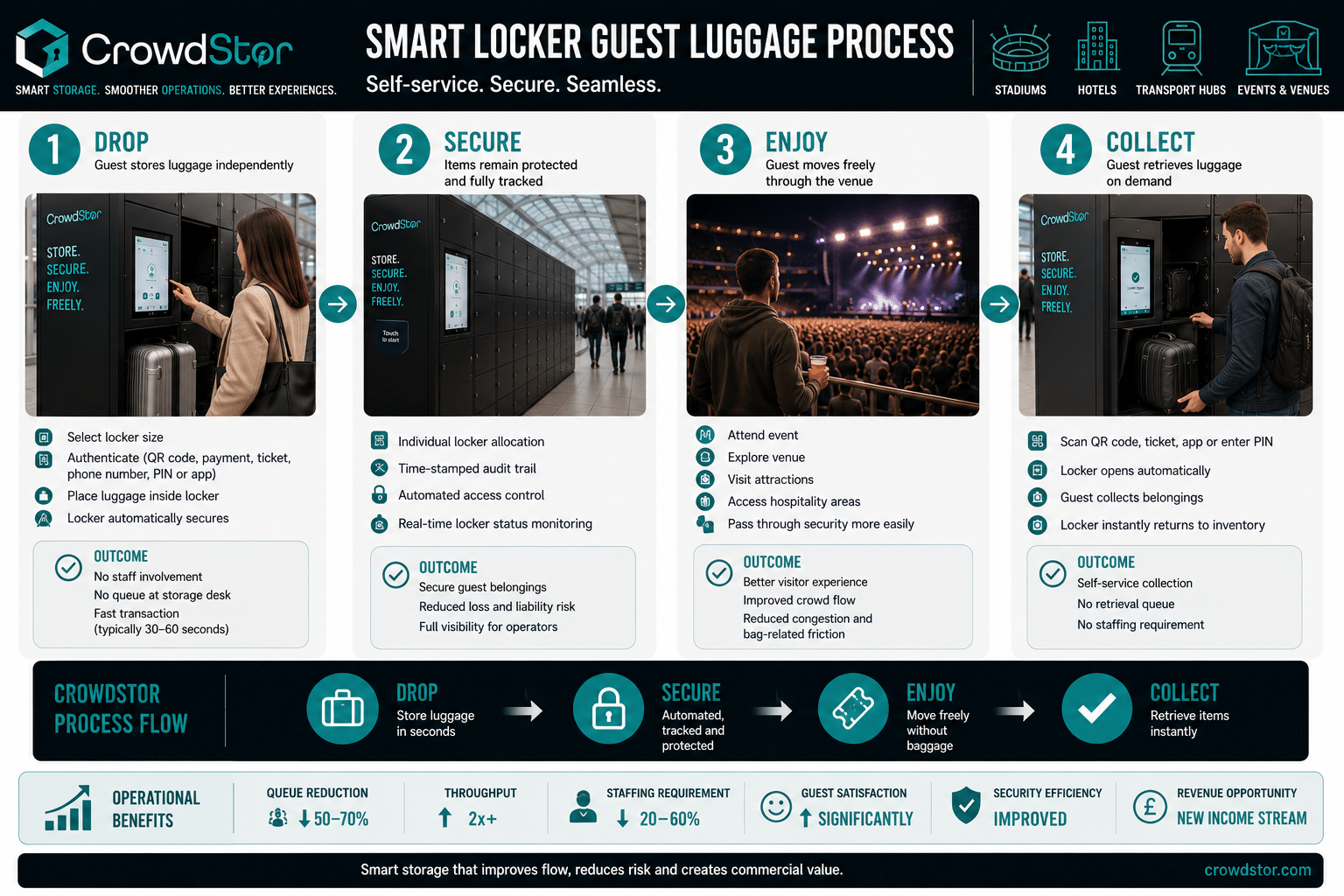
How Smart Luggage Lockers Improve Control
Smart luggage lockers provide a secure and trackable alternative to traditional storage methods.
Benefits include:
- Secure individual storage compartments
- Real-time luggage tracking
- Controlled guest access
- Reduced staff handling
- Faster luggage collection
- Improved guest experience
By replacing manual luggage processes with automated storage systems, hotels can improve visibility, reduce risk, and create more scalable luggage operations.
Smart Luggage Locker Process
Traditional Hotel Luggage Storage vs Smart Luggage Lockers





Case Study: Premier Inn Cologne & VPOD
Case Study: How Premier Inn Cologne Reduced Lost Luggage Risks
Premier Inn Cologne deployed VPOD smart luggage lockers to replace traditional luggage room operations and improve control over guest belongings.
By introducing secure self-service luggage storage, real-time tracking, and controlled access, the hotel reduced manual handling, improved accountability, and minimised the risk of misplaced luggage during busy check-in and check-out periods.
Results Included:
- 6× ROI within the first year
- Improved luggage security and tracking
- Reduced risk of misplaced luggage
- Faster luggage retrieval for guests
- Lower operational pressure on reception teams
- Enhanced guest experience and hotel efficiency
Who Is Affected by Lost Luggage?
Hotel Operations Managers & Front Desk & Guest Services Teams
Hotel Operations Managers
Key Challenges
- Lost luggage incidents during peak periods
- Limited visibility over stored bags
- Difficulty tracking luggage locations
- Managing guest complaints and service recovery
- Maintaining operational efficiency at scale
Operational Pain Points
- Staff spending time searching for luggage
- Delayed bag retrieval for guests
- Increased compensation and recovery costs
- Pressure on hotel operations teams
- Reduced accountability across storage processes