



29 smart lockers
Hotel luggage storage case study
Ibis Geneva Hotel Smart Lockers: From Reception Bottleneck to 24/7 Self-Service
How 29 connected smart lockers reduced reliance on reception, improved luggage storage for guests and delivered measurable commercial value.
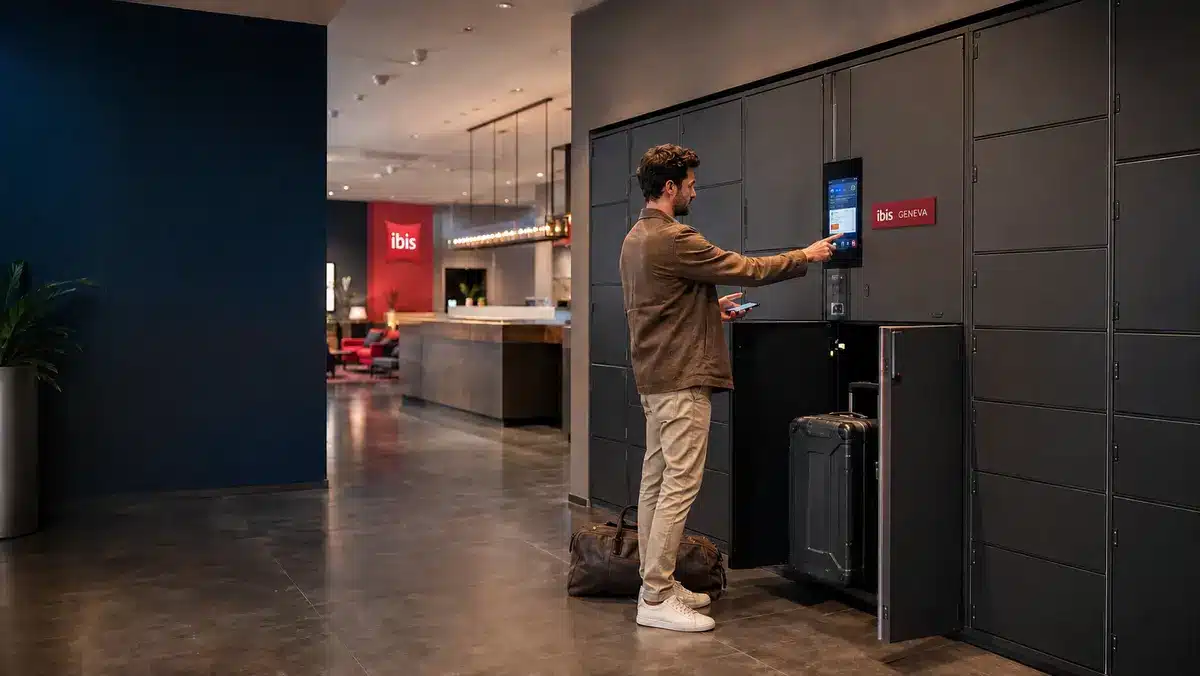
Measured deployment results
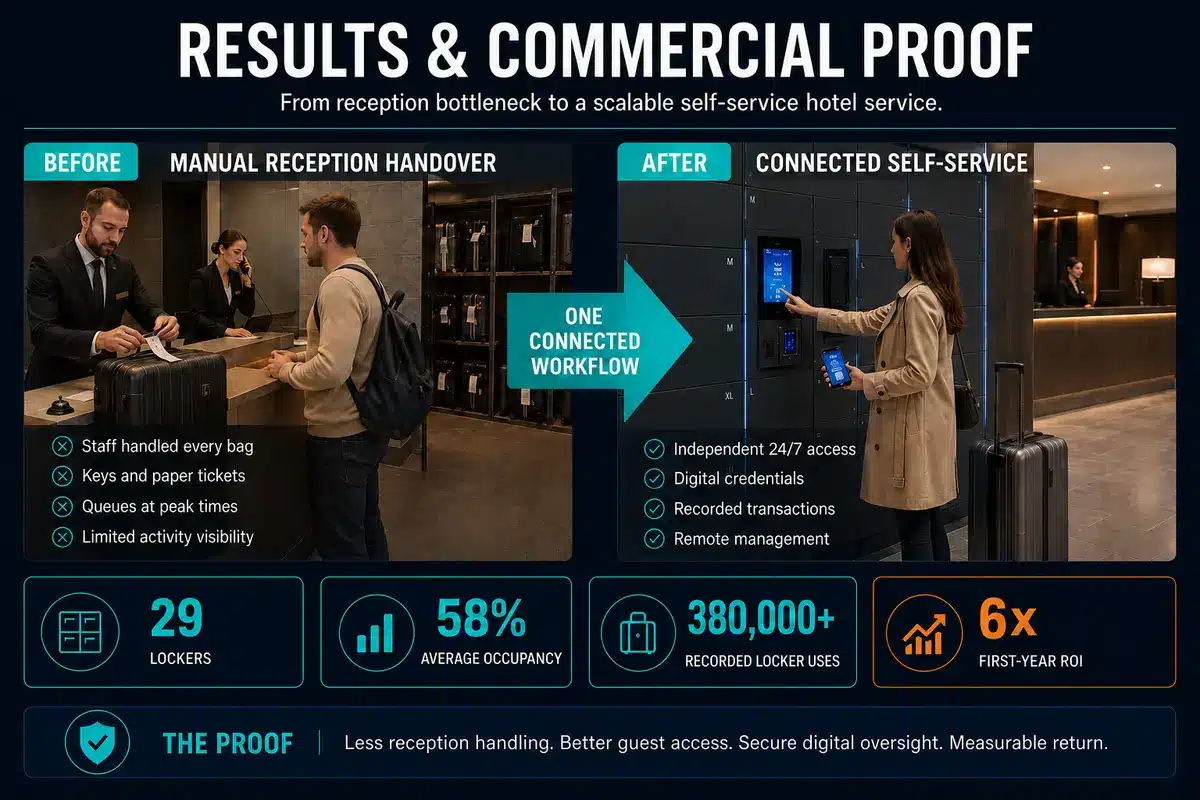
Ibis Geneva smart locker results
58% average occupancy
380,000+ recorded locker uses
6× first-year ROI
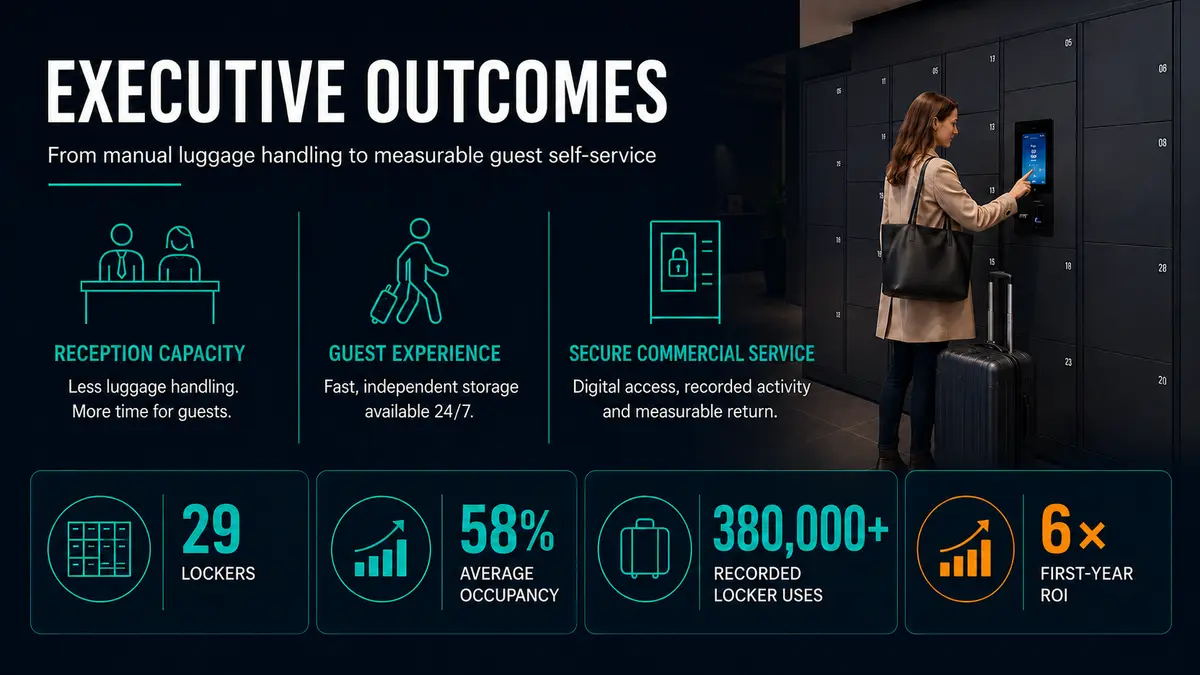
Executive outcomes
From manual luggage handling to measurable guest self-service
Ibis Geneva moved routine luggage storage away from reception and into an independently operated digital service. Early-arriving and late-departing guests can select an appropriate locker, complete the on-screen process and return to collect their belongings without asking front-of-house staff to manage every handover.
Each storage and collection event creates a digital activity record, replacing much of the dependence on physical keys, paper tickets and shared manual processes. Hotel teams gain greater operational visibility while retaining more reception capacity for check-in, enquiries and personal service. The result is not simply faster storage: sustained occupancy, more than 380,000 recorded uses and a 6× first-year return demonstrate a guest amenity with measurable commercial performance.
The customer
A globally recognised hotel brand in Geneva
Ibis serves a broad mix of leisure and business travellers in a busy international hotel market. At the Geneva property, luggage demand does not begin and end with the room booking: guests may arrive before check-in, leave after check-out or need secure short-term storage while continuing their journey.
Those patterns create concentrated periods of demand around reception. Staff must protect time for arrivals, enquiries and personal service, while guests need a dependable place for cabin bags, suitcases and larger luggage. The hotel therefore required configurable capacity rather than a single compartment size, together with a service that could remain available beyond a purely staff-led process.
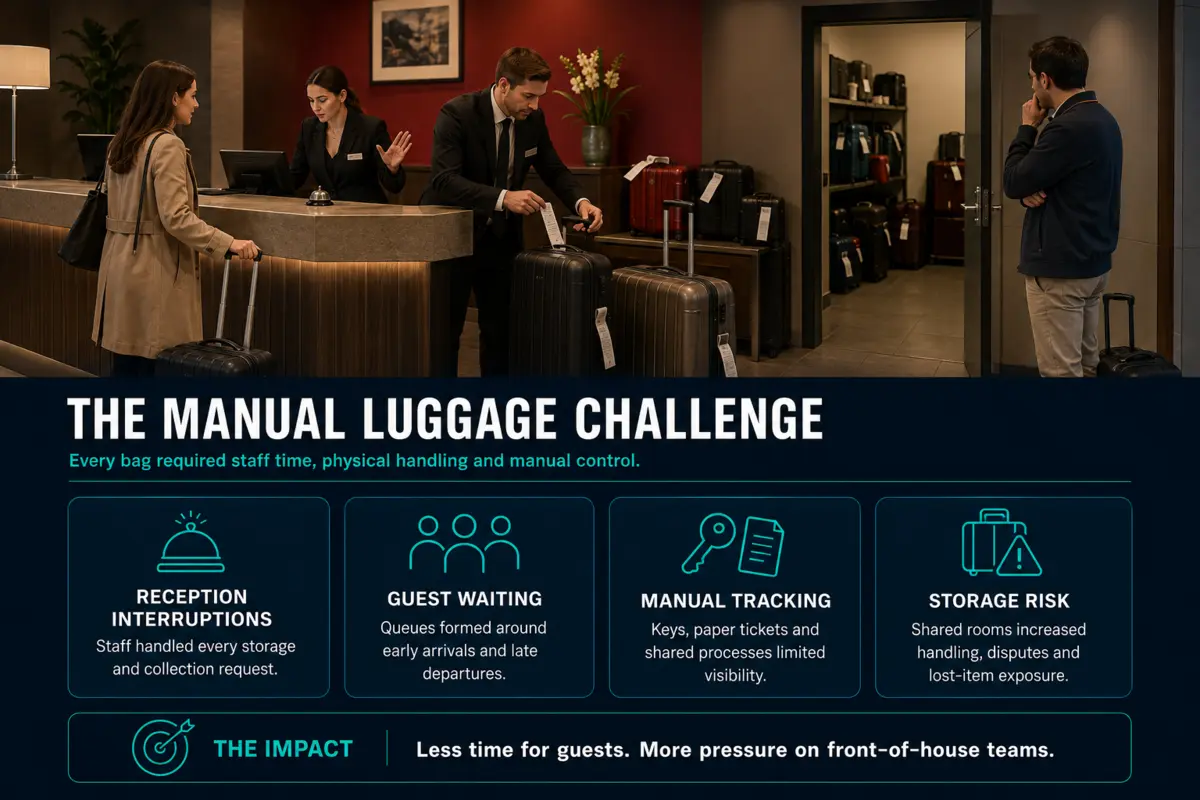
The challenge
Manual luggage handling was adding pressure at reception
Receiving, identifying, moving and retrieving bags interrupted front-of-house work and could create avoidable queues during peak arrival and departure periods.
Under a reception-led process, every bag created a sequence of staff tasks: identify the guest, issue or check a claim reference, move the luggage into shared storage and repeat the process when the guest returned. Each interruption competed with check-in and service enquiries, particularly when early arrivals and departures overlapped.
Keys, paper tickets and manually controlled storage also limited real-time visibility. Staff needed to know which bags had been accepted, where they were stored and whether collection had been completed. Different suitcase sizes made capacity harder to plan, while shared storage increased physical handling and the potential for disputes. The challenge was therefore operational, experiential and commercial—not simply a shortage of storage space.
Strategic objectives
What Ibis Geneva needed to achieve
Move luggage storage away from a repetitive reception workflow without compromising service, security or operational visibility.
Reduce waiting
Give early arrivals and late departures an independent storage journey.
Release reception
Reduce repetitive bag receipt, movement and retrieval.
Strengthen control
Replace keys and paper tickets with recorded digital access.
Create value
Operate luggage storage as a measurable ancillary service.
See how Vpod smart locker systems connect hardware and software →
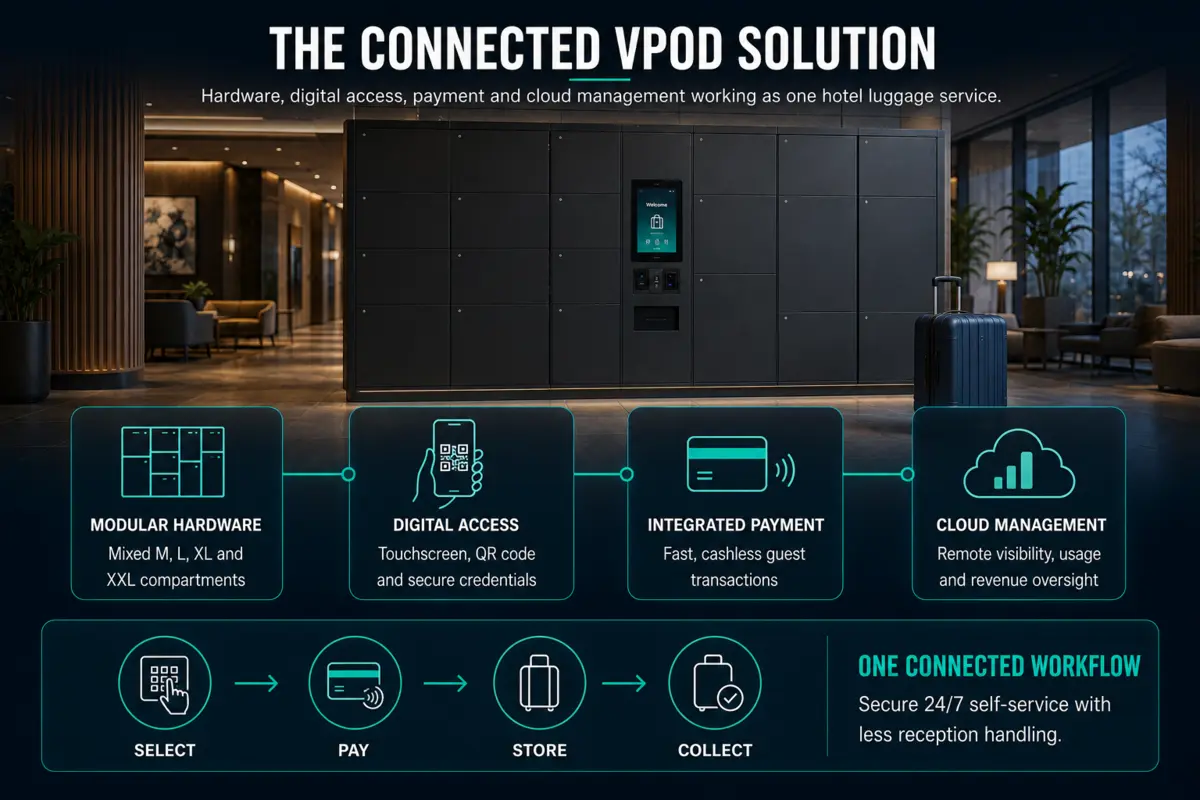
The Vpod solution
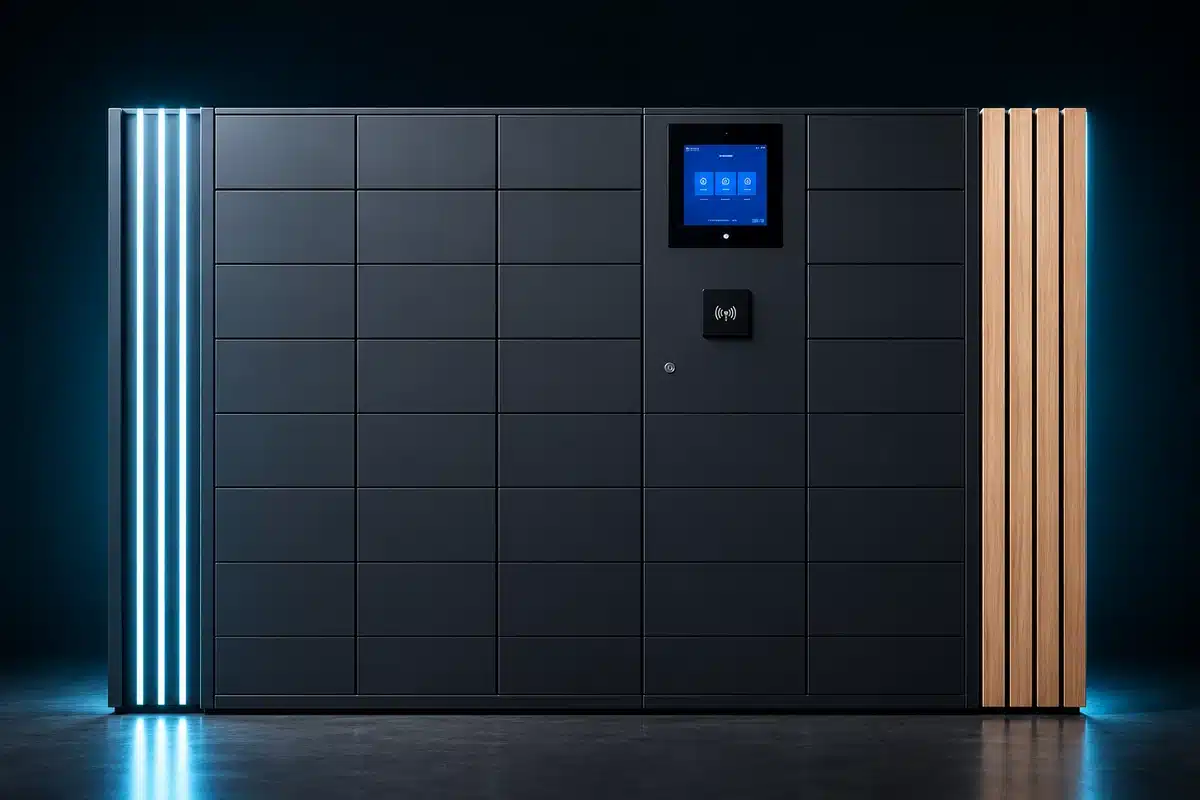
29 connected hotel smart lockers
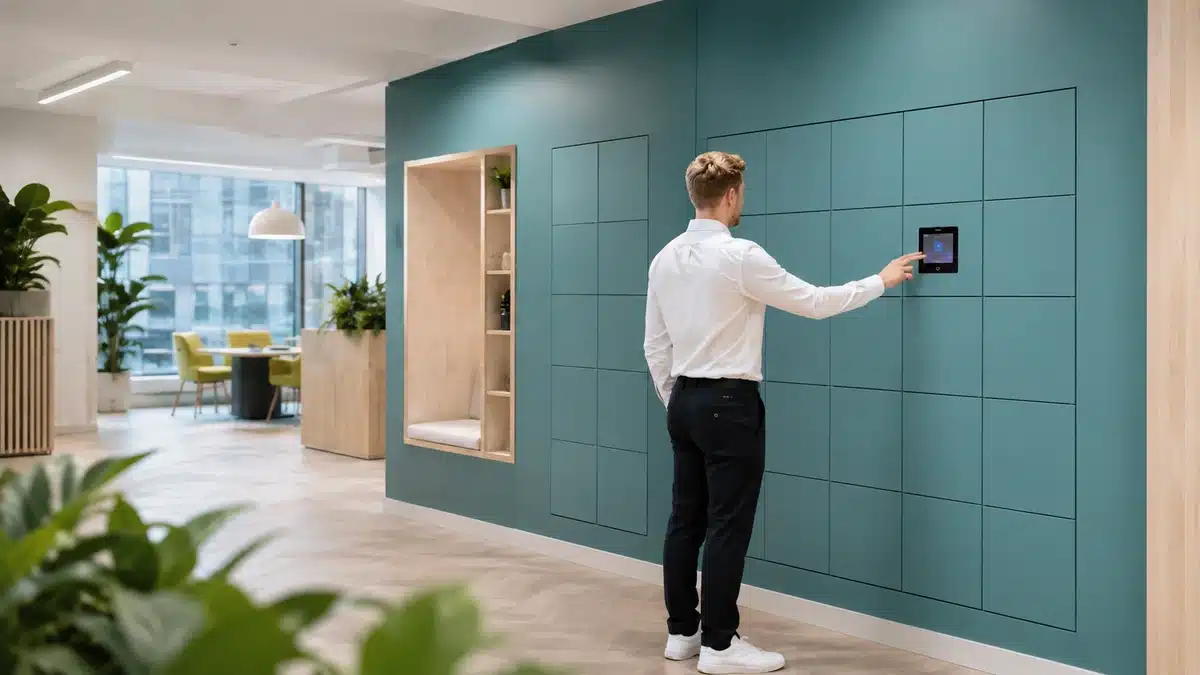
Guests begin at the locker touchscreen, select a compartment suited to their luggage and follow the digital instructions. Payment can be included where the hotel operates storage as a paid ancillary service. Once the transaction is completed, the system assigns the locker and issues an authorised digital credential for secure collection.
Mixed compartment sizes accommodate cabin bags, standard suitcases and larger luggage without forcing every item into the same format. Storage, access and collection activity is recorded, creating a clearer operational history for each transaction. Through locker management software, hotel teams can review availability, usage and system activity remotely. The result connects modular hardware, guest access, configurable payment and cloud administration in one managed workflow.
The guest journey
The guest experience: Store. Explore. Return. Collect.
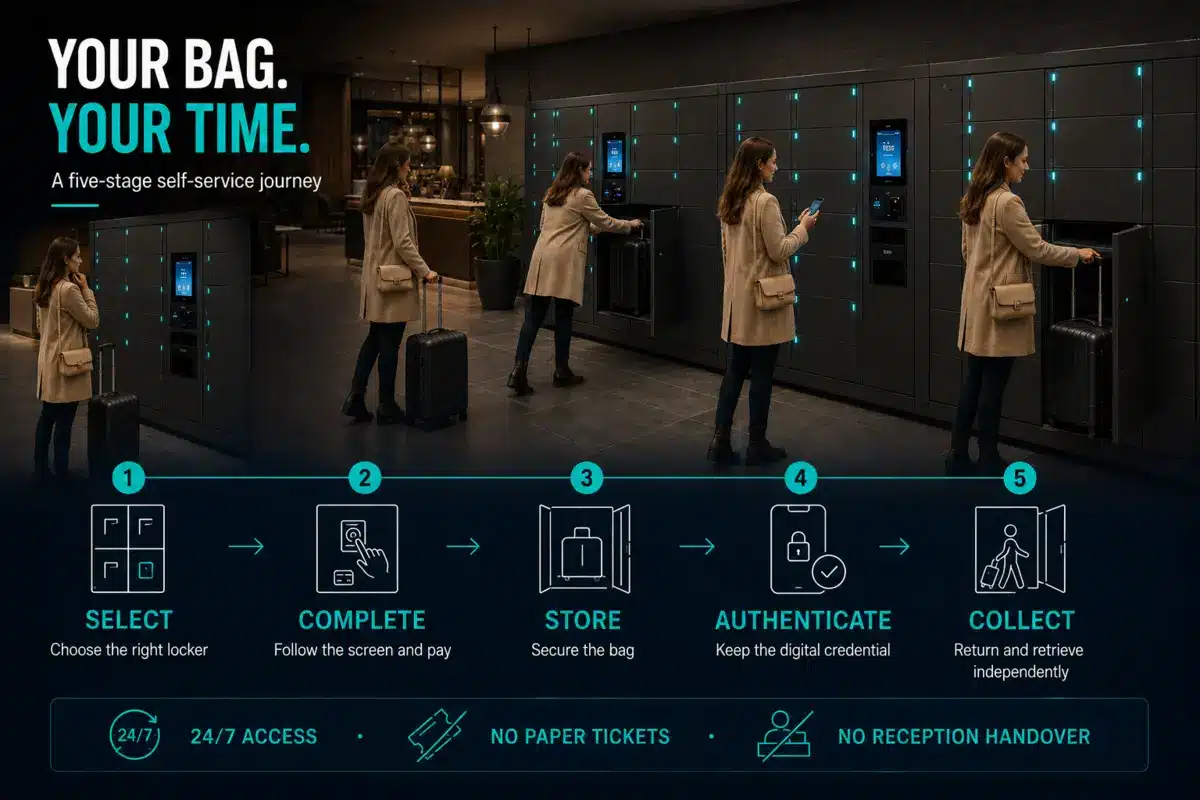
For the traveller, the experience is intentionally simple: store the bag, explore Geneva, return when convenient and collect it. Behind that simple experience is a five-stage digital workflow: select, complete, store, authenticate and collect.
The guest first chooses an available compartment that matches the luggage size, then completes the guided screen journey and payment where applicable. The assigned locker opens for storage and the authorised collection credential is retained digitally. When the guest returns, that credential confirms access to the individual locker and the collection is recorded. The same process supports early arrivals, late departures and 24/7 availability without requiring a receptionist to issue keys, manage paper tickets or retrieve the bag.
Security and accountability
Digital access and a verifiable chain of custody
Each transaction links the guest to an individually assigned locker and an authorised digital credential. Locker opening, storage access and confirmed collection can be time-stamped in the system, giving hotel teams a clearer record of activity than shared keys, handwritten labels or paper claim tickets.
This digital chain of custody reduces dependence on manually controlled storage rooms and helps teams investigate questions using verifiable records. Remote visibility also gives authorised staff a consistent view of availability and system activity without standing beside the lockers. Together, individual assignment, controlled access, recorded events and confirmed collection strengthen accountability while allowing the guest to remain independent.
Three connected outcomes
Better for operations, guests and control
Labour efficiency
Routine storage transactions move away from reception, reducing interruptions and giving front-of-house teams more time for guests.
Guest experience
Travellers gain fast, flexible access to secure storage before check-in and after check-out without waiting for staff.
Security and accountability
Individual assignment, authorised digital access and time-stamped activity create a stronger chain of custody.
Results & commercial proof
From reception bottleneck to scalable hotel service
The measured deployment demonstrates strong adoption, operational control and a commercial return from self-service luggage storage.
The results show more than a successful hardware installation. A 58% average occupancy rate indicates sustained guest demand rather than occasional use, while more than 380,000 recorded locker uses demonstrate adoption at meaningful operational scale.
For reception teams, that volume represents storage and collection events that no longer require the same repeated manual handover. For hotel management, recorded transactions and remote oversight create a more controlled service with evidence of utilisation. Commercially, the 6× first-year ROI shows that luggage storage can move from an unmanaged back-of-house obligation to a productive hotel amenity. The proof therefore combines reception capacity, guest convenience, digital accountability and measurable return.
Watch the customer story
See the Ibis Geneva deployment in practice
Explore how self-service luggage storage supports the guest journey and front-of-house operations.
Watch on YouTube
Measured value
A scalable operating model for hotel portfolios
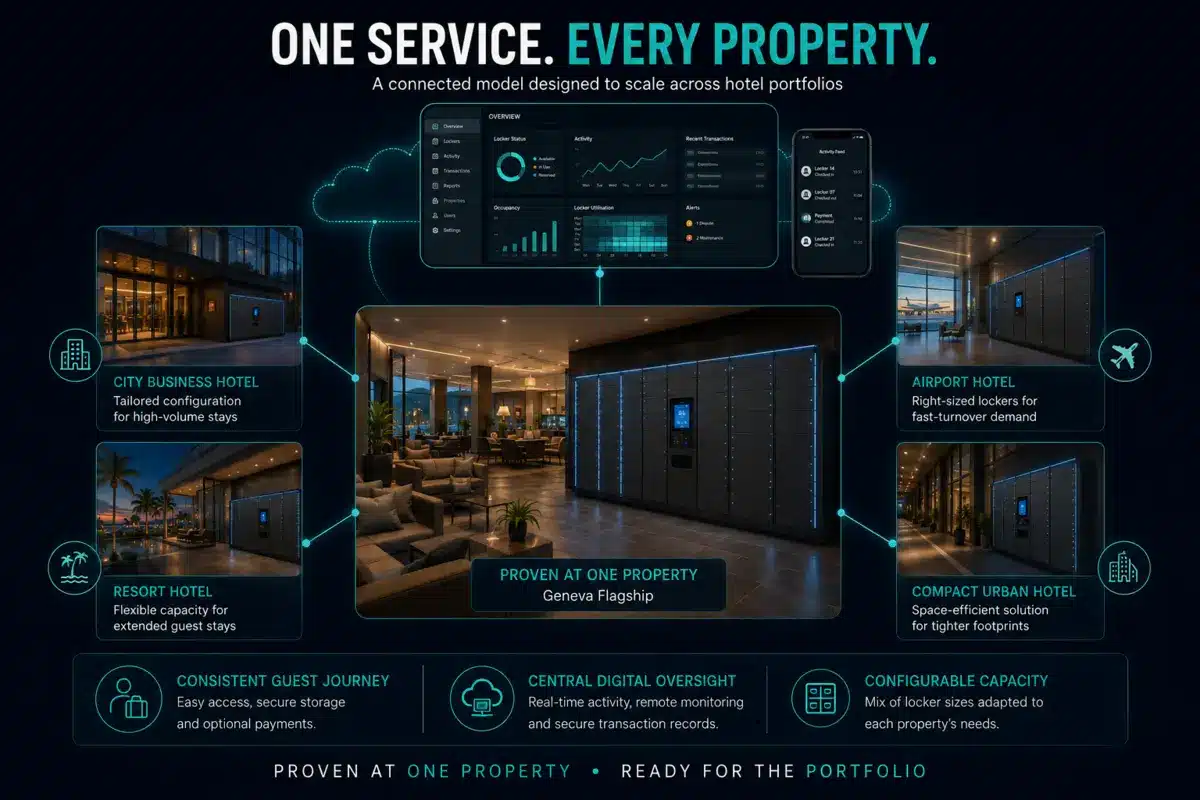
The Geneva deployment provides a proven single-property model that can be configured for different hotel footprints, luggage profiles and demand patterns. A compact urban property may prioritise space efficiency, while an airport, resort or high-volume city hotel may require a different mix of compartment sizes and capacity.
The scalable element is the operating model—not an implied existing rollout across the Ibis portfolio. A consistent guest workflow can be paired with property-specific hardware, payment rules and availability. Central administration also gives hotel groups a common basis for managing access, monitoring utilisation and reviewing performance across future locations. Geneva therefore supplies credible evidence for evaluating the model elsewhere while each subsequent property remains subject to its own capacity and workflow design.
Plan your hotel deployment
Turn luggage storage into a better guest service
Discuss demand, capacity, workflow design, payments and the commercial case for your hotel or portfolio.